Forward-Deployed Full-Stack Engineering for Autonomous Cloud MLOps
An evidence-based lifecycle control framework for autonomous cloud MLOps, analyzing how to increase deployment success rates using machine-verifiable evidence.

We proposed an evidence-based multi-agent framework that converts natural language requirements into verifiable cloud deployments. Experiments prove that controlling autonomy through lifecycle transitions only upon independent verification ensures operational stability.
Introduction
Many enterprises are attempting development automation using AI agents, but a vast gap exists between an agent claiming it has ‘succeeded’ and the system actually ‘functioning correctly’ in a production environment. MLOps, in particular, involves complex dependencies—data pipelines, model training, infrastructure provisioning, and security policies—where a single minor error in one step carries a high risk of total system collapse or severe security vulnerabilities.
In this analysis, rather than blindly trusting agent autonomy, we examine a ‘Forward-Deployed Full-Stack Engineering’ approach that controls the lifecycle through objective evidence, such as execution traces and runtime telemetry. This provides an engineering solution for how AI agents can safely build and operate systems in enterprise-grade cloud environments, moving beyond simple code generation.
What the Original Paper States
This research proposes an evidence-based multi-agent framework that automatically transforms natural language MLOps cloud engineering tasks into verified repositories and operational cloud deployments. By combining three core mechanisms—graph engineering, loop engineering, and agent harness engineering—the researchers designed a structure that determines lifecycle transitions based on machine-checkable evidence, such as execution traces and runtime telemetry, rather than agent assertions.
Experiments were conducted on 100 distinct natural language MLOps tasks within a Google Cloud Platform (GCP) environment. A total of 2,000 executions were evaluated using four LLM backbones: GPT-5.6 Sol, Gemini 2.5 Pro, Flash, and Flash-Lite. According to the analysis (Figure 2 of the source paper), the GPT-5.6 Sol model recorded the highest Verified Operational Deployment Rate (VODR) of 0.99 during nominal execution. Other models also demonstrated robustness by recovering from failures in the repository, cloud, and runtime stages via evidence-based control loops, or by terminating in an auditable terminal failure state.
Executive Key Takeaways
- 1 1. [Core Design Principle] Existing methods relying solely on autonomous agent assertions lead to opaque state transitions and policy violations; therefore, independently verifiable execution evidence must be a prerequisite for lifecycle transitions.
- 2 2. [Engineering Implications] When designing enterprise MLOps, machine-verifiable verification predicates must be established for each stage of the CI/CD/CT pipeline, with a structure implemented to automatically regress to reflection and repair loops upon failure.
- 3 3. [Operational Limitations] Beyond simple frontend-backend applications, can the same level of automated verification and recovery resilience be maintained in enterprise cloud stacks with complex legacy system integration or high-level security requirements?
How to Replace Autonomous Agent Assertions with Reliable Operational Evidence?
First, the risk of ‘Apparent Completion’ during long-term agent-based task execution must be addressed. An agent may report that a task is finished while the system remains in a stale state or policy violations occur due to errors during hand-offs between stages. To prevent this, the framework assigns a Verification Predicate to every lifecycle transition and adopts an Evidence Gate method that fundamentally blocks progression to the next stage unless machine-checkable evidence is submitted.
Second, there is a stark gap in Recovery Resilience depending on model performance. According to the researchers’ analysis (Figure 7 of the source paper), GPT-5.6 Sol showed a nearly perfect Recovery Success Rate (RSR) during repository and runtime verification failures, whereas lightweight models like Gemini Flash-Lite saw recovery rates drop to 0.34 during repository verification failures. This suggests that while the system’s ‘control structure’ operates independently of the model, the ‘recovery capability’ to diagnose and fix actual failures depends heavily on the LLM’s reasoning capacity.
Third, there is a need for boundary setting to prevent infinite loops and resource waste. If an agent falls into a modify-verify loop, token consumption and time costs increase exponentially. To control this, the framework introduces the concept of a Retry Budget; if the verification predicate is not met within the set number of attempts, the system is forced into a terminal failure state and the reason is recorded in an auditable log, ensuring operational efficiency.

An LLM agent reporting task completion is merely the result of logical reasoning, not physical evidence reflecting the actual state of the infrastructure. Automation systems lacking evidence-based verification loops accumulate invisible technical debt, which eventually manifests as unpredictable failures in production.
Therefore, every agent workflow must include an independent Verification Agent and an isolated execution environment (Sandbox), where telemetry derived from execution results serves as the sole condition for forward progression.
Three Engineering Mechanisms for Evidence-Based Lifecycle Control
The core of this framework lies in a structure where system transitions are determined by machine-verifiable evidence rather than the autonomous judgment of the agent. To achieve this, the researchers introduced three pillars—Graph Engineering, Loop Engineering, and Agent Harness Engineering—to strictly control the MLOps lifecycle.
Graph Engineering, the first pillar, structures the entire MLOps lifecycle as a state-based execution graph. Looking at the architecture (Figure 2 of the source paper), a Graph Orchestrator coordinates the collaboration of specialized agents responsible for repository creation, review, execution, verification, release, and monitoring. Specifically, the orchestrator manages not only workflow states and dependencies but also Evidence Gates, permitting transitions to the next stage only when machine evidence proves the Verification Predicate has been met. This mechanism fundamentally eliminates the risk of state inconsistency during long-term tasks by trusting only objective data, such as execution traces, rather than the subjective ‘complete’ status reported by an agent.
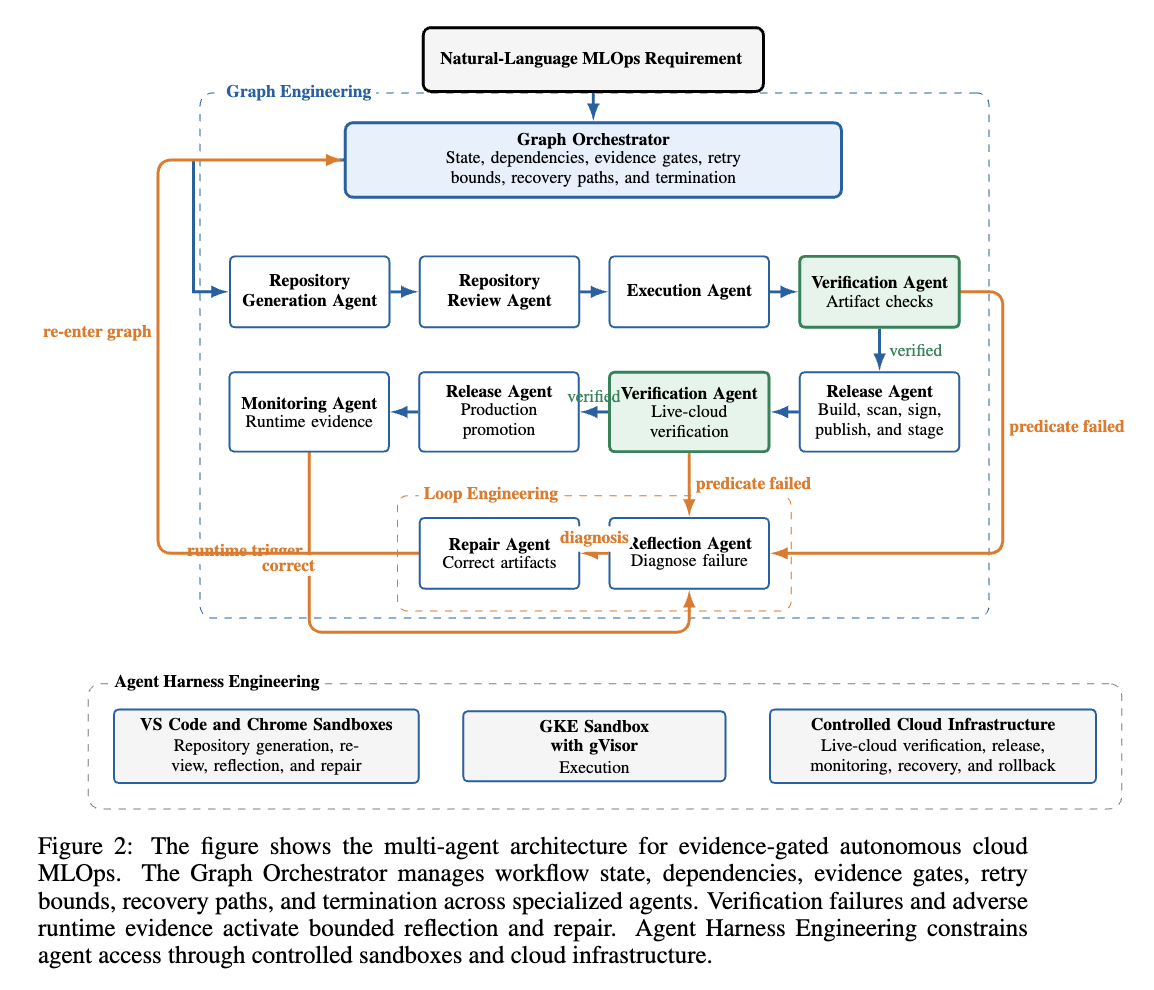
Second is Loop Engineering, which defines bounded control cycles that trigger upon verification failure. According to the design (Figure 2 of the source paper), if a verification agent detects a failure, that evidence immediately triggers a diagnosis by a Reflection Agent and action by a Repair Agent. The modified artifact must then pass through the review and verification stages again, a process that repeats only within a predefined Retry Budget. This loop structure prevents agents from wasting resources in infinite modification cycles while ensuring recovery resilience by enabling automated recovery and rollbacks during runtime concept drift or performance degradation.
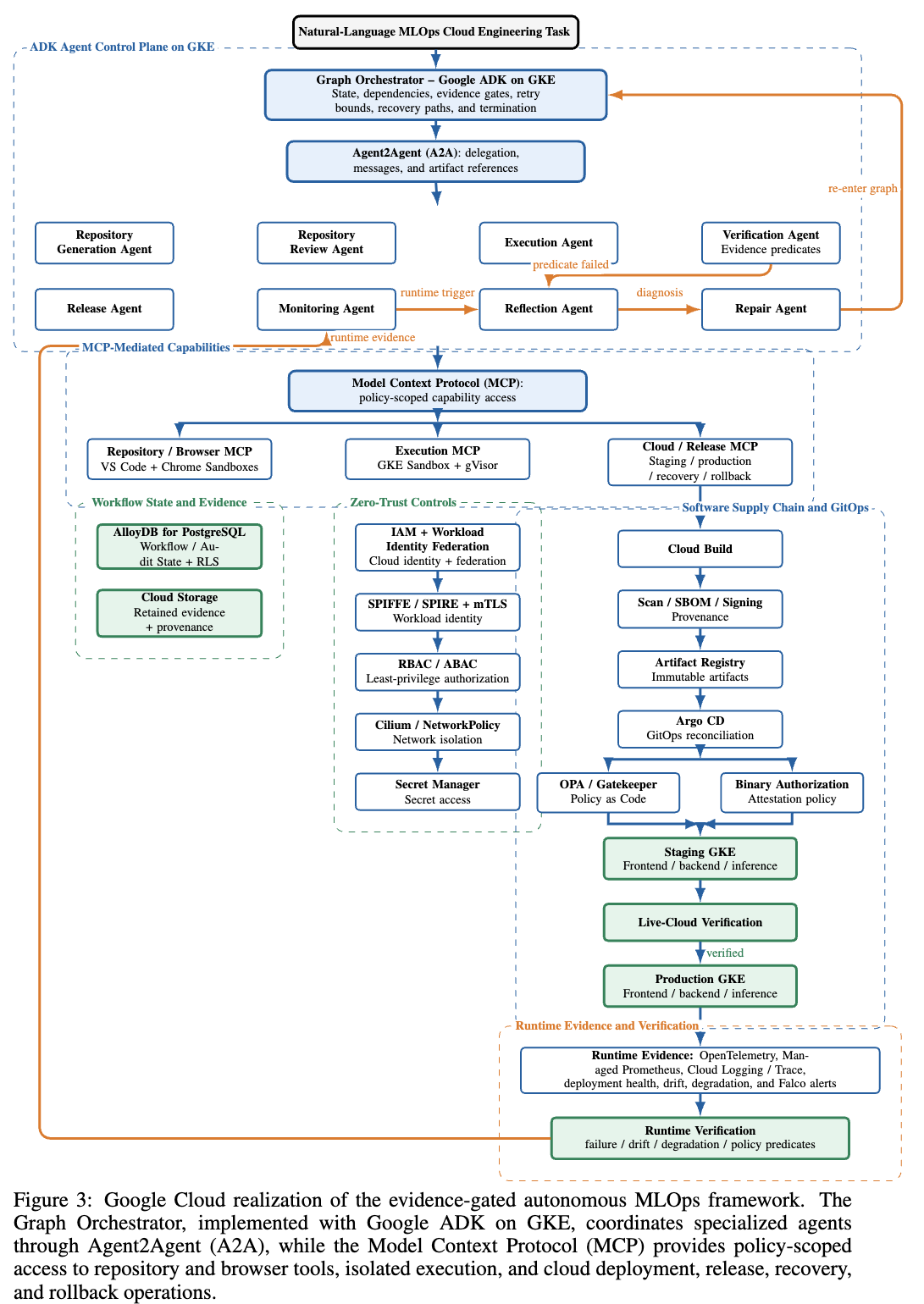
The third pillar, Agent Harness Engineering, serves as a control framework that strictly limits the tools and execution environments accessible to the agent. In the detailed implementation (Figure 3 of the source paper), repository creation and modification agents are isolated within VS Code and Chrome sandbox environments, while actual artifact execution takes place in a GKE Sandbox with gVisor. Furthermore, by granting policy-based functional access through the Model Context Protocol (MCP), the system physically blocks agents from accessing unauthorized cloud resources or violating security policies. This is an essential safeguard that minimizes unpredictable operational risks associated with agent autonomy and ensures all execution processes occur in an auditable environment.
Operational Implementation on Google Cloud and Zero Trust Security Architecture
This framework leverages Google Cloud Platform (GCP) infrastructure to strictly isolate and control the AI agent’s execution environment. Specifically, the execution of artifacts generated by agents takes place within a GKE Sandbox isolated by gVisor. This prevents agent-generated code from directly impacting the host system and ensures that only machine-checkable evidence generated during execution is extracted and delivered to the verification agent. Without this isolation, a single mistake or the generation of malicious code by an agent could pose a fatal risk, potentially leading to the collapse of the entire cloud infrastructure.
To ensure software supply chain stability, the researchers built a sophisticated release pipeline. Source compilation and container builds are performed via Cloud Build, during which static analysis security scanning (SAST) and container scanning, including CVE detection, are mandated. Integrity is guaranteed through the generation and signing of a Software Bill of Materials (SBOM) and the creation of SLSA-based provenance. Subsequently, artifacts are deployed to the staging environment via GitOps-based state reconciliation using Argo CD, policy control via OPA/Gatekeeper, and Binary Authorization. This multi-stage verification system fundamentally blocks unverified artifacts from entering the production environment.
To prevent the abuse of agent privileges, a Zero Trust security architecture is composed of a five-layer defense system, as analyzed in the source paper (Figure 12 of the source paper). The first layer controls cloud resource access via IAM and Workload Identity Federation. The second layer mandates identity verification and encrypted communication between workloads by introducing SPIFFE/SPIRE and mutual TLS (mTLS), a strategy that eliminates internal network trust and explicitly authenticates all service-to-service communication.
In the third and fourth layers, the principle of least privilege is applied by combining Role-Based Access Control (RBAC) and Attribute-Based Access Control (ABAC), and pod-to-pod communication is physically isolated through Cilium and Kubernetes NetworkPolicy. Finally, sensitive credentials are managed centrally via Secret Manager. This hierarchical security structure serves as a critical safeguard, preventing agents from acquiring privileges beyond their assigned roles or performing lateral movement to other vulnerable points in the network.
Analysis of Recovery Resilience and Verification Success Rates by LLM Backbone
The reasoning capability of the LLM backbone acts as a core variable for Recovery Resilience—the ability to diagnose and restore a system to a normal state after failure—beyond simple code generation. According to the analysis (Figure 2 of the source paper), in terms of Verified Operational Deployment Rate (VODR), GPT-5.6 Sol recorded an overwhelming performance of 0.99 during nominal execution, while performance dropped sharply for Gemini 2.5 Pro (0.78), Flash (0.52), and Flash-Lite (0.38). This gap remained consistent across perturbation scenarios involving repository, cloud, and runtime verification.
The performance difference between models is more evident in the specific Recovery Success Rate (RSR) during failure scenarios than in simple success rates. Experimental results (Figure 7 of the source paper) show that GPT-5.6 Sol achieved very high recovery success rates of 0.97–0.98 across all verification failure points (repository, cloud, and runtime), demonstrating virtually perfect self-healing capabilities. Conversely, Gemini 2.5 Flash-Lite showed a severe limitation, with the recovery rate dropping to 0.34 during repository verification failures. This suggests that lower-tier models lack the reasoning ability to accurately diagnose and correct root causes of errors within complex MLOps dependency relationships.
A key analytical point here is the complete decoupling of the system’s ‘control structure’ and ‘recovery capability.’ Despite all models operating under the same control framework (the Evidence Gate), the massive gap in actual deployment success rates proves that applying strict rules alone is insufficient to guarantee system stability. While an evidence-based gate acts as a safeguard against ‘incorrect forward progression,’ the ability to actually modify an artifact to pass that gate depends purely on the LLM’s intellectual capacity.
In conclusion, implementing autonomous MLOps in environments with low-reasoning models is a highly risky decision. Agents lacking recovery capabilities are likely to quickly exhaust their Retry Budget and transition to a terminal failure state, leading to direct costs in terms of wasted engineering resources and project delays. Therefore, implementing enterprise-grade MLOps automation requires both the engineering design of a verification loop and the selection of a high-performance LLM backbone capable of handling such complexity.
Framework Evaluation Metrics
To quantitatively measure the performance and robustness of the framework, the researchers systematically defined comprehensive metrics to determine overall system success and detailed metrics for each lifecycle stage. The top-level key metric is the Verified Operational Deployment Rate (VODR). This does not simply mean deployment is complete; it measures whether the system was deployed in an operational state by satisfying three core verification predicates: repository verification (), release verification (), and runtime verification (). By calculating the final success rate based on machine evidence rather than subjective agent reports, the actual reliability of autonomous engineering is visualized.
Two metrics are used during the initial repository creation and acceptance stages. The first is the Repository Completeness Score (RCS), which evaluates how faithfully essential artifact categories—from application code to CI/CD pipelines, Infrastructure as Code (IaC), and security policies—were generated. The second is the Repository Acceptance Rate (RAR), which measures whether the generated repository ultimately satisfied the repository verification predicate (). Analysis (Figure 3 of the source paper) reveals cases where RCS is high but RAR is low, suggesting the risk that a simple list of components does not guarantee functional logical completeness.
Strictness during system execution and transition is measured by the Controlled Execution Rate (CER) and transition-related metrics. CER verifies whether executable artifacts were safely processed within the gVisor-based GKE Sandbox and whether verifiable execution evidence was preserved. To evaluate the control capability of the Graph Orchestrator, the Verified Progression Rate (VPR) and Blocked Forward Progression Rate (BFR) were introduced. VPR measures whether transitions were normally permitted upon meeting verification conditions, and BFR measures whether transitions were strictly blocked when conditions were not met, proving the system’s deterministic control capability.
Finally, in the cloud deployment and recovery resilience stages, the Release and Promotion Success Rate (RPSR) and Recovery Success Rate (RSR) are calculated. RPSR measures the proportion promoted to production after staging deployment and cloud verification, while RSR evaluates the proportion successfully corrected and transitioned again within the Retry Budget after a verification failure. Specifically, the Exhaustion Termination Rate (ETR), which measures whether the system terminated correctly in an auditable failure state upon exhausting the retry budget, serves as a key safeguard ensuring that autonomous agents operate within a controlled range without entering infinite loops.
Evidence-Based Verification Checklist for Autonomous MLOps Adoption
- Definition of Verification Predicates: Are machine-verifiable metrics that define ‘success’ clearly established for each lifecycle stage (build, deploy, runtime)?
- Provision of Isolated Execution Environment (Sandbox): Can agent-generated artifacts be safely executed in an isolated environment like gVisor to collect evidence before application to the real environment?
- Recovery Loop and Retry Budget Configuration: Is there a designed path for regression to Reflection and Repair agents upon verification failure, and is a maximum retry limit specified to prevent infinite loops?
- Runtime Telemetry Integration: Is an observability system in place to detect drift or performance degradation post-deployment and automatically trigger a correction loop?
Shift in Operational Paradigm Brought by Autonomous Engineering
The core of the framework presented in this research is not ‘autonomy’ but ‘constraint.’ Paradoxically, autonomous deployment became possible only because the agent’s scope of action was strictly limited and a harness structure was implemented that demands evidence at every stage. This indicates that enterprise AI strategies should shift from searching for ‘smarter models’ to designing ‘more sophisticated control loops.’
However, the scope covered in this paper is limited to relatively standardized applications combining frontend and backend. In real enterprise environments, far more demanding verification conditions exist, such as complex network security policies, data governance regulations, and interoperability between heterogeneous clouds. Whether LLMs can find appropriate correction paths when these variables are added remains an area requiring further verification.
Evidence-Based Autonomous MLOps Operational Principles
These are three core principles that engineering teams must follow to ensure the reliability of agentic workflows.
- Evidence-First Principle: Prioritize machine-verifiable evidence—such as runtime logs, test results, and security scan reports—over agent text reports when determining state transitions.
- Isolated Execution Principle: All generated artifacts must undergo a verification process in an isolated sandbox environment before production promotion, and all traces generated during this process must be preserved.
- Finite Recovery Principle: Assign a strict Retry Budget to all modification and recovery loops; upon budget exhaustion, force termination and record the auditable cause of failure for handover to a human engineer.
Further reading
- Practical Considerations for MLOps Practices: Why Tool Adoption Does Not Prevent Failure
- Why MLOps Maturity Models Are Necessary: Why Best Practice Lists Fail to Transform Organizations
- Utilizing Machine Learning for Failure Prediction After Collective Changes in Automated Continuous Integration Testing
References and Original Analysis Materials
Forward-Deployed Full-Stack Engineering for Autonomous Cloud MLOps
Authors: Sagar Srinivas Sakhinana, Venkataramana Runkana
Venue / Publisher: arXiv
This research briefing was written from the source paper with the help of AI tools (AI Research Agent · MLOps, AI Research Agent · Strategy). Reviewed by Jay PARK, who is responsible for it.
Read more

Tech & MLOps ·
ADAZOR: Hypothesis Testing for Concept Drift Detection in Machine Learning
Tech & MLOps ·
Trust Must Survive Deployment: The Continuous Assurance Lifecycle for Adaptive AI Systems

Tech & MLOps ·
AI Safety and Security Technical Debt in AI-Enabled System Engineering

Tech & MLOps ·
The Limits of Machine Learning Models of Misinformation
