The Role of Artificial Intelligence and Machine Learning in Cloud-Native Systems
Analyzes strategies for integrating AI/ML into cloud-native systems to achieve resource optimization and autonomous operations via predictive scaling.

This study analyzes integrating AI/ML into cloud-native environments to enhance resource management, failure prediction, and autonomous operational efficiency. Results indicate that AI-driven predictive scaling and self-healing mechanisms significantly improve distributed system resilience.
Introduction
Modern enterprise IT infrastructure has rapidly transitioned from monolithic systems to cloud-native environments where numerous microservices are organically interconnected. The complexity of these distributed systems has reached a level where efficient management is no longer possible using threshold-based rules manually configured by human operators.
In this context, attempts to integrate AI and machine learning directly into the infrastructure operations layer are not merely about efficiency improvements but are directly linked to system survivability. This analysis examines how cloud-native systems can evolve from reactive operations to predictive autonomous operations through AI and identifies the core technical elements required in that process.
Analysis of the Original Paper
This paper explores the functional and scalable changes brought about by the combination of cloud-native infrastructure and artificial intelligence (AI) and machine learning (ML) in modern enterprise distributed systems. Specifically, it focuses on implementation methods for dynamic resource allocation, predictive scaling, and self-healing systems using AI algorithms within Microservices Architecture (MSA) environments.
The researchers conducted a comparative analysis between traditional static provisioning and AI-based optimization. In particular, they review the efficacy of anomaly detection in Network Function Virtualization (NFV) configurations and vulnerability-based trust models within a Service Mesh. While specific experimental data or numerical performance metrics are not explicitly stated, the paper presents a synthesis of prior research indicating that AI-based weighted load balancing algorithms outperform traditional Round-robin methods.
Executive Key Takeaways
- 1 1. [Core Value] Traditional rule-based reactive cloud operation methods have limitations in optimizing resource efficiency within highly volatile workloads and complex microservices environments.
- 2 2. [Operational Implications] Enterprise AI leaders must expand MLOps strategies beyond simple model deployment toward integrating AI at the infrastructure level to build predictive resource allocation and autonomous failure recovery systems.
- 3 3. [Technical Challenge] How will we control unpredictable system chain reactions that may occur when various AI-based autonomous operational tools interact within a complex environment?
Can AI-based Autonomous Operational Systems Actually Resolve the Complexity of Distributed Environments?
First, the limitations of traditional reactive scaling and the potential of AI prediction models are analyzed. Because existing systems allocate resources only after performance thresholds are exceeded, service degradation is inevitable during sudden traffic spikes. This paper suggests that real-time workload prediction models can proactively identify changes in demand, simultaneously mitigating the risks of cost waste due to over-provisioning and performance degradation due to under-provisioning.
Second, resource optimization efficiency within Microservices Architecture (MSA) is examined. Compared to rehost systems, MSA exhibits high and irregular variability in resource requirements. AI-based dynamic resource allocation analyzes multi-dimensional telemetry data—including CPU, memory, and network bandwidth—to distribute optimal resources in real-time, providing an alternative to solve the resource fragmentation and waste caused by static allocation.
Third, the effectiveness of self-healing and anomaly detection frameworks is analyzed. In NFV environments, simple threshold-based monitoring often misses subtle anomaly signs, which can lead to large-scale failures. ML-based anomaly detection aims for a structure that discovers potential failure signs early through multi-dimensional feature analysis and maintains service availability without human intervention via automated recovery workflows.
Move beyond rules that simply increase servers when CPU usage reaches 80%; instead, integrate ML models that have learned historical time-series patterns and real-time traffic signals into your scaling policies. This allows for the proactive acquisition of resources before traffic peaks occur, fundamentally preventing the degradation of user experience.
Analysis of AI-based Resource Optimization and Self-healing Frameworks
AI-based optimization mechanisms for maximizing resource efficiency in cloud-native environments are defined as the combination of real-time analysis of multi-dimensional telemetry data and automated control loops. According to the Intelligent Resource Optimization Framework (Figure 1 of the source paper) presented by the researchers, the system continuously collects extensive operational data, including CPU utilization, memory occupancy patterns, network bandwidth, and storage I/O behavior. The AI model learns workload volatility based on this data and executes Dynamic Allocation to overcome the limitations of static provisioning, particularly in Microservices Architecture (MSA) where resource demand fluctuations are severe.
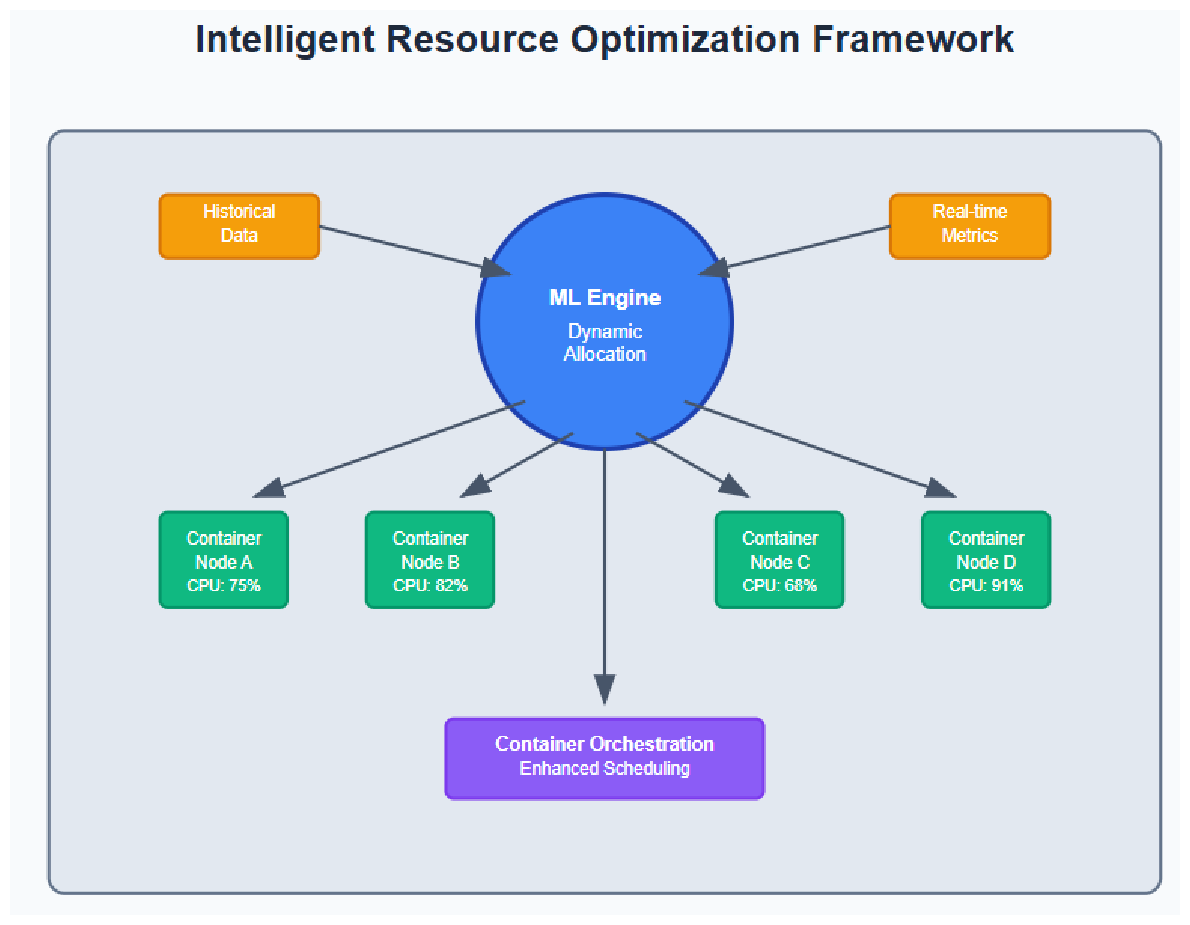
The first core mechanism is the advancement of Container Orchestration. The AI model analyzes cluster topology and runtime behavior to establish optimal container placement strategies. This goes beyond simply placing containers on nodes with high available resources; it is a structure that minimizes resource conflicts and optimizes the processing performance of the entire cluster by simultaneously considering resource affinity rules and security policies. In the absence of such intelligent placement, there is a high risk of hotspot phenomena where load concentrates on specific nodes, degrading overall system availability.
The second core mechanism is the self-healing workflow linked to anomaly detection. The AI-based self-healing system architecture (Figure 3 of the source paper) focuses on capturing subtle behavioral pattern inconsistencies occurring in Network Function Virtualization (NFV) environments. Anomaly detection models applying supervised, unsupervised, and hybrid techniques identify potential failure signs that threshold-based monitoring often misses, enabling preventive measures before service interruption.
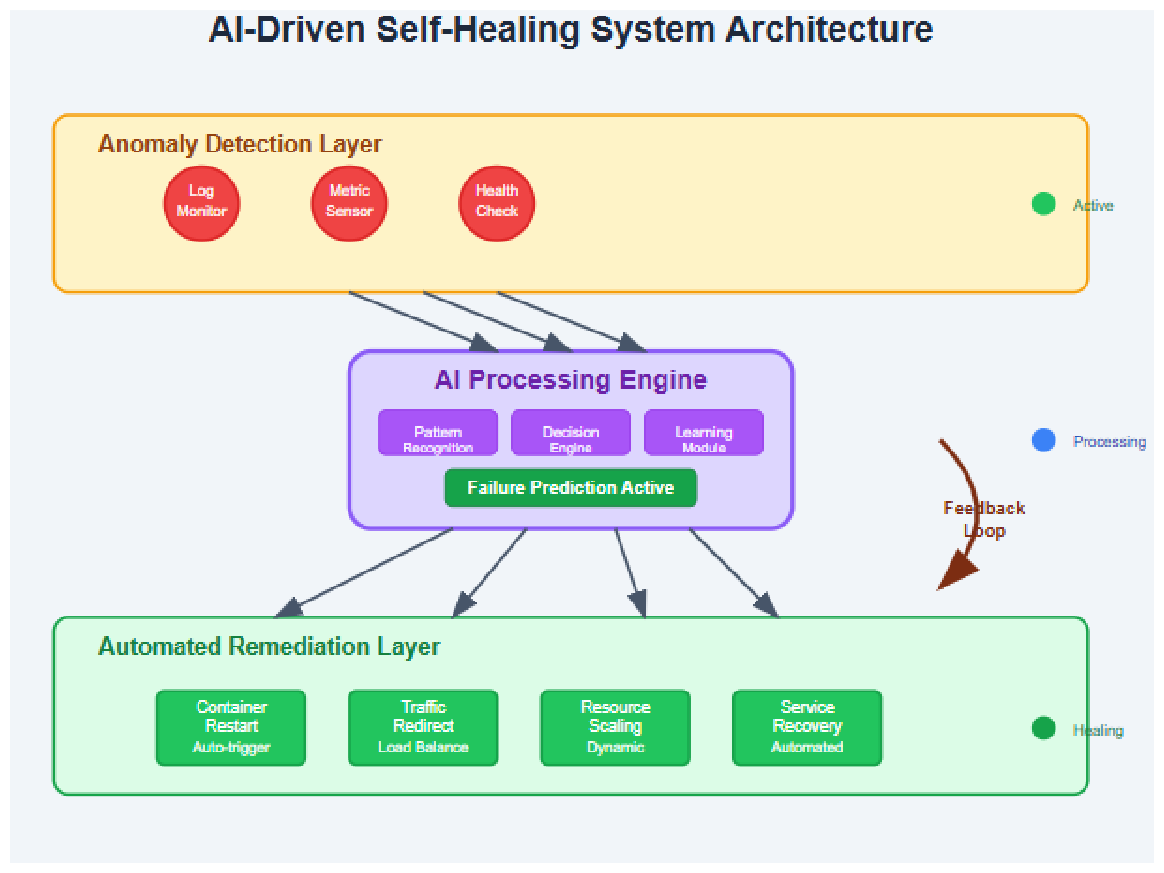
Finally, identified anomalies are immediately linked to automated recovery workflows. The self-healing system analyzes failure patterns and autonomously performs specific remedial actions such as automated container restarts, traffic redistribution, scaling, and failover. This closed-loop control system drastically reduces the time for manual operator intervention and enables evolution toward Autonomous Operations, where the system diagnoses and recovers its own state. The original text analyzes that these mechanisms lead to tangible results in operating cost reduction and service availability improvement.
Performance Comparison of Predictive Scaling and Load Balancing
Traditional Reactive Scaling systems have a lagging structure that allocates resources only after a specific performance threshold is exceeded. This approach has a critical limitation: during unpredictable traffic surges, the speed of resource allocation cannot keep pace with the increase in demand, leading to service degradation and resource contention. According to the performance comparison analysis (Figure 2 of the source paper), AI-based Predictive Scaling overcomes these inherent flaws of reactive systems by proactively identifying demand changes through real-time workload prediction models.
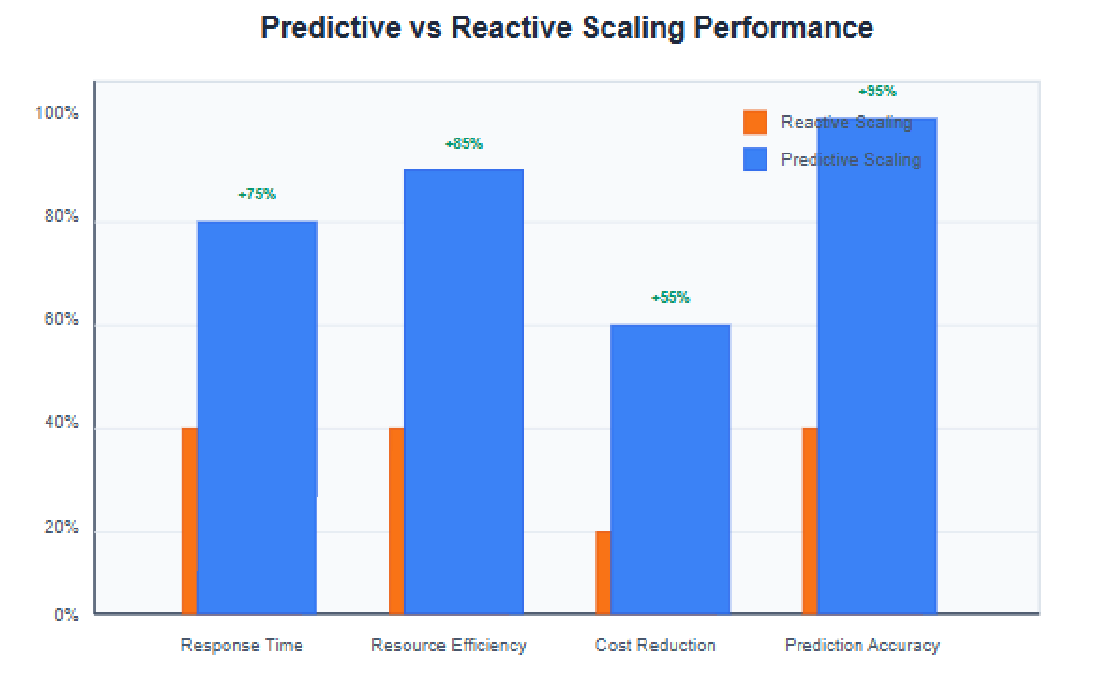
The core of predictive scaling is the utilization of machine learning models that learn time-series patterns, seasonal variability, and operational trends beyond simple monitoring. This model calculates future resource requirements by analyzing complex datasets including service performance metrics, infrastructure operational statistics, and even external market trends. Consequently, the system mitigates the conflicting risks of service interruption due to under-provisioning and cost waste due to over-provisioning by securing optimal resources before actual demand spikes.
In the area of load balancing, a transition is occurring from simple distribution methods to intelligent optimization methods. Traditional Round-robin or Least Connection methods mechanically distribute traffic without considering the actual processing capacity or current state of the server. This causes imbalance where load concentrates on specific nodes, increasing the latency of the entire system.
Conversely, weight-assignment-based intelligent load balancing algorithms evaluate multi-dimensional indicators such as resource utilization, processing capacity, and service-specific characteristics of each server in real-time. According to prior research cited in the paper, this dynamic weight adjustment method ensures superior resource efficiency and service quality compared to the Round-robin method by flexibly changing the traffic distribution ratio based on server performance status. Ultimately, the combination of predictive scaling and intelligent load balancing becomes an essential strategy for simultaneously securing reduced operating costs and optimized user experience in cloud-native environments.
Structure of the Vulnerability-Driven Trust Model within Service Mesh
In a distributed microservices environment, the core of security lies in how trust relationships between services are established and managed. According to the analysis (Figure 4 of the source paper), integrating a Vulnerability-Driven Trust Model into a Service Mesh architecture can overcome the limitations of static security policies and drastically increase system adaptability. The core of this model is to construct trust relationships between microservices dynamically based on real-time vulnerability assessment results rather than fixed rules.
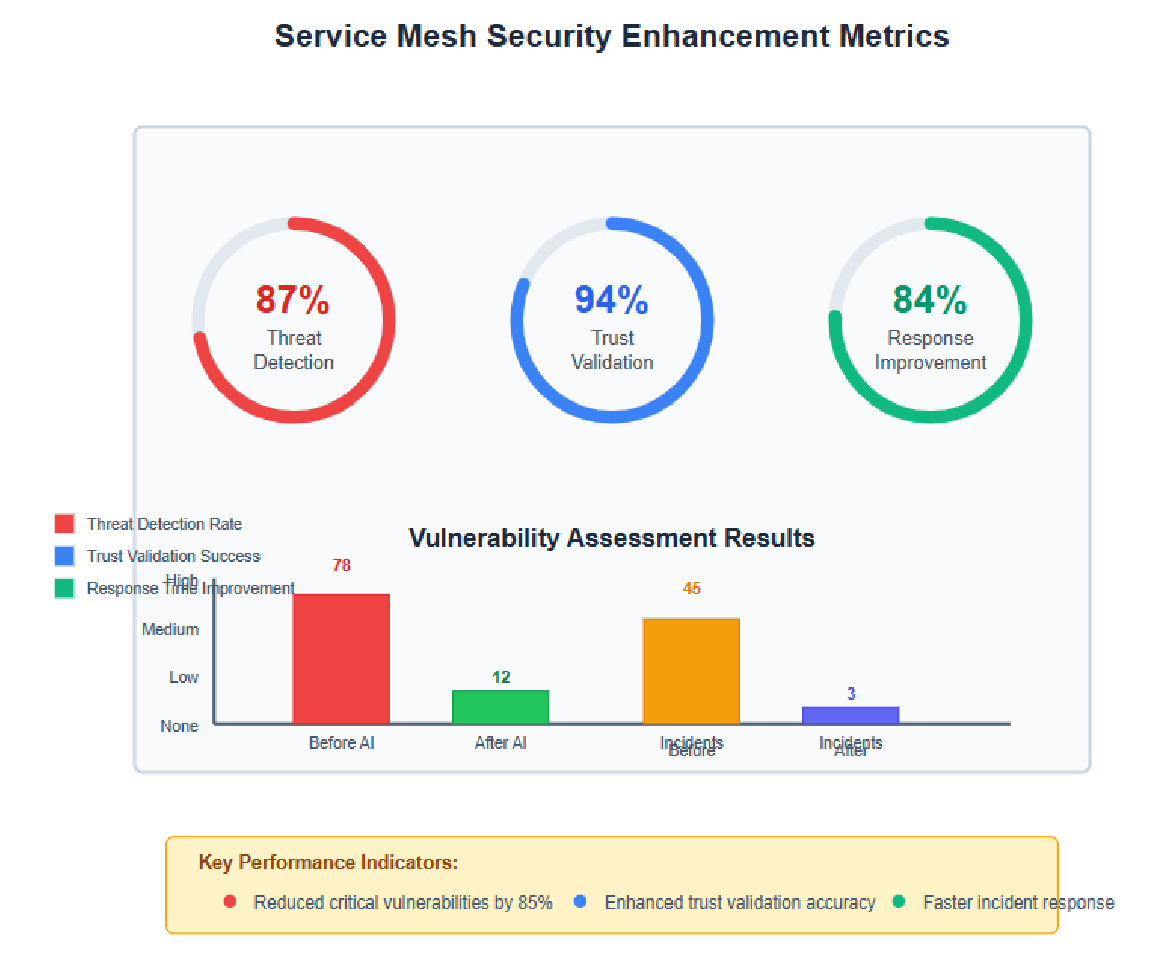
The first mechanism is the quantification of trust relationships through precise vulnerability assessment. The system determines trust levels by comprehensively analyzing the security status of each service, the latest threat intelligence, and service signals. Unlike traditional methods that grant trust based simply on certificates, this model creates Trust Connections through continuous security analysis and threat assessment practices. If a serious security flaw is discovered in a specific service, the trust level is immediately downgraded, and access permissions to that service are restricted.
The second is the combination of real-time monitoring and dynamic security policies. The intelligent service mesh management platform constantly monitors communication patterns and vulnerability signs between services and modifies access policies in real-time according to the threat level. This allows for proactive responses before potential security threats spread through the entire system and is a decisive factor in reducing response time during security incidents. This dynamic adaptation system acts as a key device to fill unexpected security gaps that may occur in a complex microservices ecosystem.
Finally, this vulnerability-driven trust model aims for an optimal balance between security enhancement and system performance. The paper suggests that by integrating the vulnerability assessment model into the service mesh, security efficiency can be maximized while preventing performance degradation caused by unnecessary verification procedures through intelligent management of trust relationships. As a result, this structure serves as the foundation for early identification of invisible security threats in distributed computing environments and ensures the overall resilience of the infrastructure through automated security policy enforcement.
Review Checklist Prior to Adopting AI-based Cloud-Native Infrastructure
- Securing Telemetry Data Pipelines: Is high-resolution CPU, memory, network, and storage I/O data being collected in real-time for AI model training?
- Predictive Model Feedback Loop Design: Is there a system to measure whether resource allocation decisions made by the AI actually led to performance improvements and reflect this back into model training?
- Safeguards for Self-healing Workflows: Is a Circuit Breaker designed to prevent automated recovery tasks (e.g., container restarts) from entering infinite loops or causing cascading failures across the entire system?
- Service Mesh Security Model Review: Is a vulnerability-driven trust model applied so that communication permissions between microservices are dynamically controlled according to real-time threat levels?
Changes in the Operational Paradigm Brought by Infrastructure AI Integration
The goal of AI-based autonomous operations presented in this paper is highly encouraging; however, in actual enterprise environments, it hits a massive wall called ‘Controllability.’ The prospect of the entire cluster going down due to a model’s misjudgment when resource allocation and recovery authority are delegated to AI is the greatest fear for operators. Therefore, a gradual transition toward a ‘Human-in-the-loop’ approach is essential rather than full autonomy.
Notably, the scope of MLOps is now expanding beyond improving model accuracy into the realm of ‘AIOps,’ where models control the infrastructure. This requires close collaboration between data scientists and infrastructure engineers and necessitates the design of new feedback loops where the infrastructure state itself becomes a feature for the ML model.
Three Design Principles for Building Autonomous Operational Infrastructure
To maximize operational efficiency through AI in cloud-native environments, the following principles must be observed:
- Incremental Granting of Autonomy: Apply a gradual trust model starting from simple monitoring and recommendation phases, granting automated recovery authority only for verified scenarios.
- Prioritizing Observability: Ensure detailed logs and metrics are secured so that the reasoning behind AI model decisions can be traced, enabling post-analysis of autonomous operational results.
- Maintaining Deterministic Safeguards: Always maintain minimum deterministic hard limits and fallback mechanisms that guarantee the absolute survival of the system regardless of AI predictions.
Further reading
- A Multivocal Review of MLOps Practices, Challenges and Open Issues
- Hidden Technical Debt in Machine Learning Systems
- Analysis of AI-Driven Workflow Restructuring and Employment Shifts at Anthropic
References and Original Analysis Materials
The Role of Artificial Intelligence and Machine Learning in Cloud-Native Systems
This research briefing was written from the source paper with the help of AI tools (AI Research Agent · MLOps, AI Research Agent · Strategy). Reviewed by Jay PARK, who is responsible for it.
Read more

Tech & MLOps ·
ADAZOR: Hypothesis Testing for Concept Drift Detection in Machine Learning
Tech & MLOps ·
Trust Must Survive Deployment: The Continuous Assurance Lifecycle for Adaptive AI Systems

Tech & MLOps ·
AI Safety and Security Technical Debt in AI-Enabled System Engineering

Tech & MLOps ·
The Limits of Machine Learning Models of Misinformation
