Working with AI: AI Adoption Strategies and Organizational Restructuring Based on Anthropic Enterprise Customer Interviews
Analysis of 58 Anthropic enterprise customers explores organizational factors determining AI success, focusing on role expansion and bottleneck-driven restructuring.

Analysis of 58 Anthropic enterprise customers confirms that the highest value is created when organizations move beyond simple automation toward role expansion and restructuring focused on bottleneck tasks.
Introduction
Many enterprises adopt generative AI expecting productivity innovation, yet in practice, they experience a vast gap between benchmark performance and actual business value. Even after technical implementation is complete, projects frequently fail due to practitioner resistance or process misalignment.
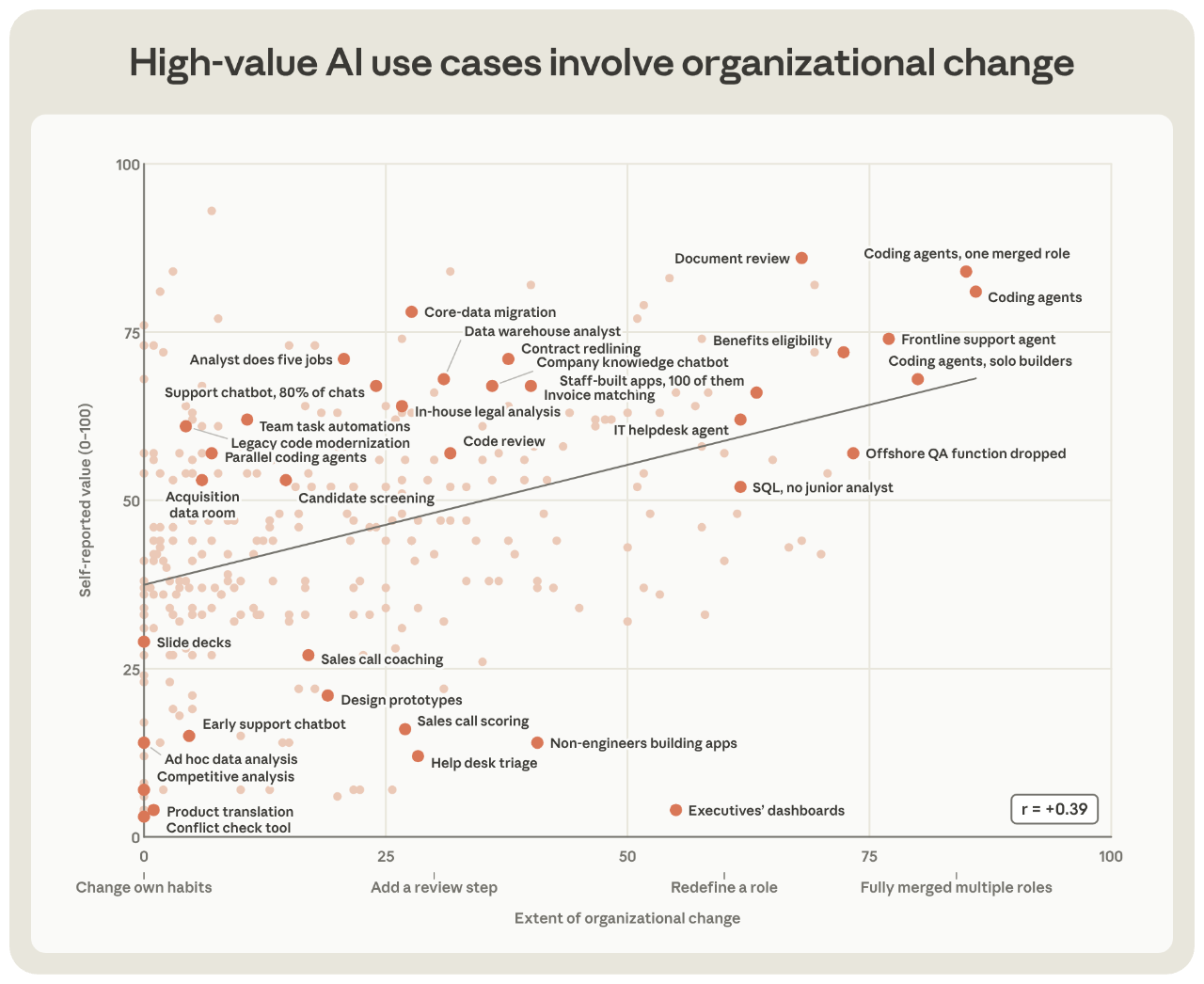
The Anthropic research analyzed here approaches AI adoption not as a simple software replacement, but from the perspective of ‘Organizational Change Management.’ Using empirical interview data, it demonstrates how an organization must move when AI accelerates basic tasks such as coding and documentation.
This report is critical for enterprise AI leaders and ML engineers because it points out that the productivity gains brought by AI agents actually create new bottlenecks within the organization. As coding speed increases, the review stage becomes the bottleneck; as data extraction accelerates, the strategic decision-making stage becomes the bottleneck.
Ultimately, the success of an AI project depends not on the number of model parameters, but on the managerial decision of where to redeploy the time liberated by AI and which role boundaries to dissolve.
Key Findings
Based on in-depth interviews with 66 executives, managers, and practitioners from 58 of Anthropic’s enterprise customers, this report analyzes the current state of AI adoption and its bottlenecks. Researchers examined approximately 300 AI applications to consider the correlation between value creation and organizational change.
The analysis indicates that AI adds value primarily through increasing output—by accelerating existing tasks or improving service quality—rather than through cost reduction. In particular, a trend was observed where the software development capabilities of non-technical staff expanded via coding agents.
Regarding adoption strategies, the report notes the limitations of top-down automation and bottom-up experimentation. Top-down approaches trigger expert resistance and fear of surveillance, while bottom-up approaches often result in the creation of individual ‘hobby-level’ tools that fail to improve overall organizational productivity, creating a bottleneck.
The most successful cases were companies that undertook ‘Reorganizing around AI.’ These firms expanded individual employee roles to the level of the entire workflow, redeployed personnel to bottleneck tasks that AI cannot solve, and established infrastructure for data democratization, allowing non-technical staff to perform analysis directly.
Executive Key Takeaways
- 1 1. [Core of Value Creation] Simple tool adoption or fragmented automation hits bottlenecks such as expert resistance and fragmented productivity gains, failing to translate into overall organizational value.
- 2 2. [Organizational Design Implications] The success of AI adoption depends not on technical implementation, but on organizational restructuring that redesigns job roles around 'remaining bottleneck tasks' and expands workflow ownership beyond the areas replaced by AI.
- 3 3. [Remaining Uncertainties] In a situation where AI model performance continues to evolve rapidly, how can a dynamic governance system be built that allows for flexible role modification rather than a fixed organizational design?
Why Must AI Adoption Move Beyond ‘Adding a Tool’ to ‘Organizational Restructuring’?
First, the vulnerability of top-down automation stems from the psychological resistance of experts and system rigidity. According to the researchers’ analysis, when management designates specific workflows for automation, it instills job insecurity and fear of surveillance in practitioners. Experts with high levels of specialization, in particular, face the paradoxical situation of having to design and verify the very system that will replace them, leading them to intentionally lower efficiency or reject adoption. This results in the mass production of low-quality automation tools, such as ‘zombie apps,’ which are impossible to maintain.
Second, bottom-up experimentation falls into the trap of ‘local optimization,’ where productivity gains remain fragmented. Some power users create personal productivity tools through ‘vibe-coding,’ but these remain in the personal domain without integrating into the organization’s standard processes. Analysis in the source paper (see Figure 4 of the source paper) shows that a lack of review capacity for AI outputs and uneven adoption speeds act as primary bottlenecks to value realization. Specifically, when productivity increases abnormally in only one area, subsequent work stages cannot absorb the load, meaning the throughput of the entire value chain does not improve.
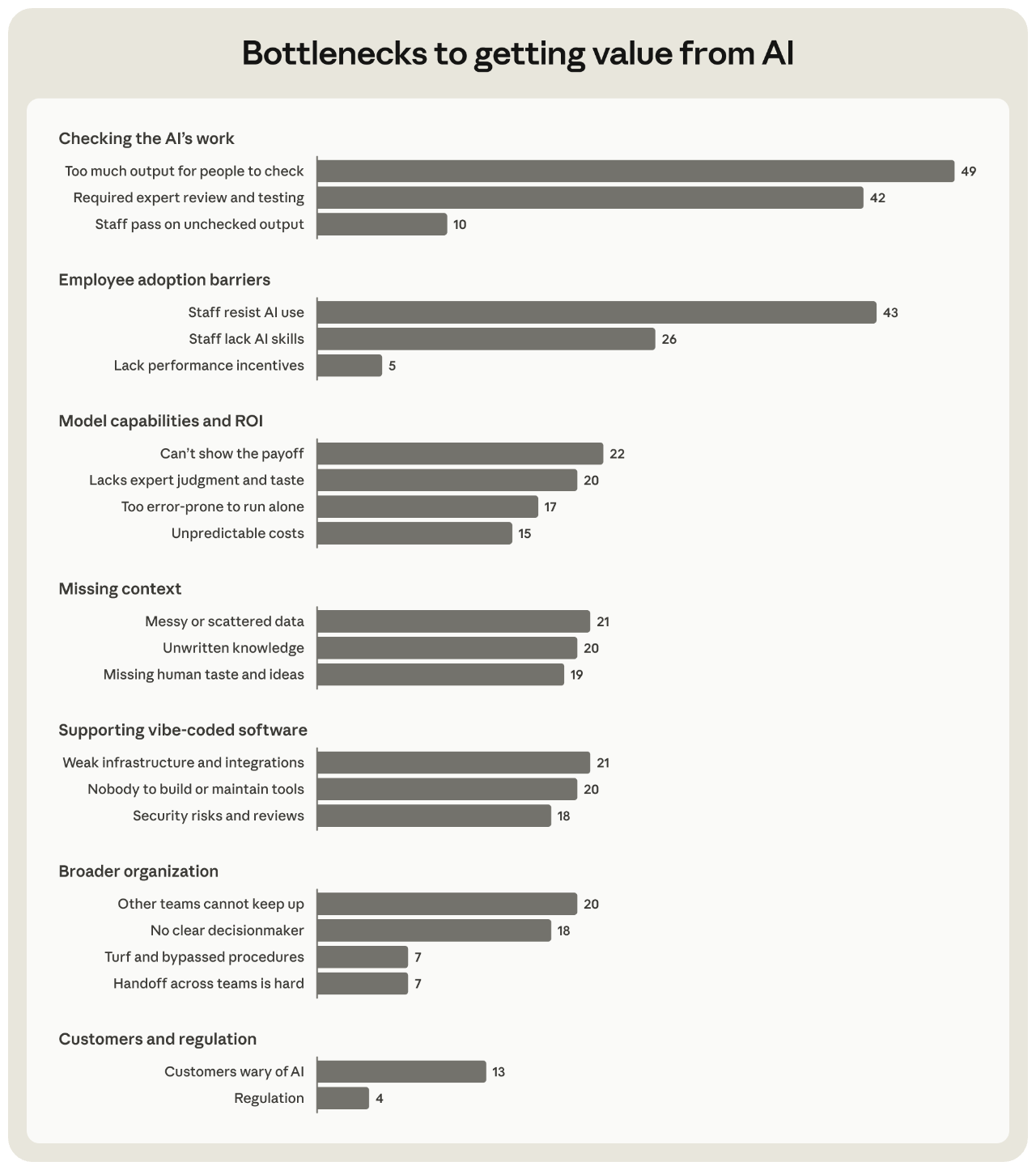
Third, the value created by AI manifests as ‘increased output’ and ‘improved quality’ rather than cost reduction; to accommodate this, Role Broadening is essential. According to the researchers’ analysis (see Figure 2 of the source paper), the primary value of AI adoption comes from accelerating existing tasks and introducing new services. However, if AI is introduced while maintaining narrow existing job definitions, employees with increased efficiency end up with idle time, and overall organizational coordination costs remain high. To solve this, structural changes—dissolving boundaries between designers, engineers, and product managers so that individuals own the entire workflow—must accompany the technology to convert AI’s potential into real business impact.
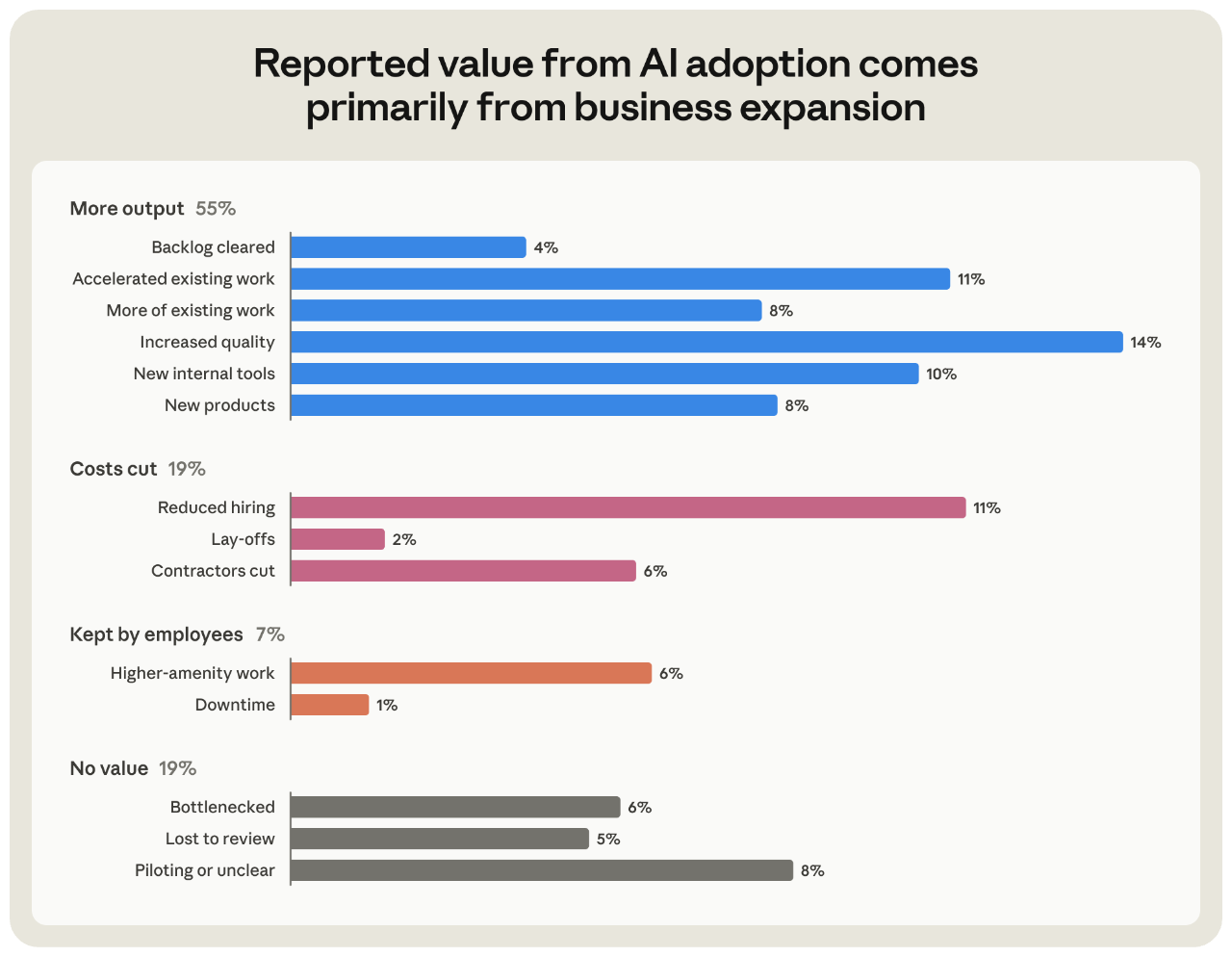

Increasing the speed of a specific task by 10x through AI does not mean the entire process becomes 10x faster. Rather, it causes ‘bottleneck migration,’ shifting an unmanageable workload onto the human reviewers or decision-makers in the next stage.
For example, if an AI agent generates thousands of reports instantly, the workload for the senior manager who must review them explodes. Introducing technology without organizational mechanisms to resolve this bottleneck (e.g., automating the review process or decentralizing review authority) is a dangerous choice that leads to total system collapse or severe quality degradation.
Three Paths of AI Adoption Strategy: Top-Down, Bottom-Up, and Organizational Restructuring
The first path is top-down automation, where management leads by designating and automating specific workflows. While this appears to bring rapid efficiency gains, it contains a fatal flaw: the psychological resistance of expert practitioners. According to interviews, experts feel they are building their ‘own coffin’ by designing and verifying systems that will ultimately replace their jobs. This perception leads to passive resistance, such as uncooperative behavior during system construction or intentionally slow reviews of AI outputs. Consequently, low-quality ‘zombie apps’—built by external vendors without field context—are mass-produced, remaining as technical debt that is neglected even as model performance improves.
The second path is bottom-up experimentation, where individual practitioners autonomously develop and apply tools. ‘Vibe-coding,’ where non-technical experts use AI coding tools to implement domain knowledge as software, is central to this path. Local successes are observed, such as an accountant who built a 401(k) contribution audit app, drastically reducing task time from 80 hours. However, these successes struggle to scale into systemic organizational improvements. Apps built at the individual level lack maintenance and support systems, making them unsustainable; as seen in 140 AI-generated software cases analyzed by the researchers, most remain simple internal dashboards or basic apps.
Bottom-up approaches also trigger new conflicts termed ‘productivity imbalances.’ When the massive volume of output generated by AI power users is passed to other team members, those unprepared for the load perceive it as a threatening workload, referred to as ‘Claude grenades’ or ‘Claude cannons.’ The review-capacity and uneven-adoption bottlenecks noted above (see Figure 4 of the source paper) suggest that optimizing speed at a single point does not increase overall value chain throughput and instead risks increasing political conflict and coordination costs within the organization.
The third and most advanced path is Reorganizing around AI, which goes beyond simple automation to redesign the organizational structure. The core of this strategy is first, ‘Role Broadening,’ expanding job scopes so individuals own the entire workflow. For example, engineers are tasked with product design and customer touchpoints beyond simple coding to minimize coordination costs. This assumes that since AI handles lower-level tasks like coding and analysis, humans can manage the overall process from a broader perspective.
Second is the strategic redeployment of human resources to ‘Bottleneck tasks’ that AI cannot solve. In one case, a software engineer completely transitioned their role from ‘writing code’ to ‘making decisions’ once code writing was automated. Project managers at a construction firm used the time liberated by AI agents—who replaced daily report writing—to focus on high-value interpersonal tasks such as improving customer experience. This approach maximizes overall organizational productivity by shifting liberated time into domains requiring strategic judgment and human insight.
Finally, building a common infrastructure to realize data democratization is essential to support this restructuring. Some successful companies built data warehouses, providing an environment where non-technical managers could extract and analyze necessary data directly via SQL queries. This removed the existing bottleneck of the data analysis team and increased organizational agility by allowing field practitioners to make immediate data-driven decisions. Ultimately, the success of AI adoption depends not on which tool is used, but on the structural decision of how to redefine authority and roles to match the nature of work changed by technology.
Empirical Cases of Role Broadening and Job Redeployment
To convert AI-driven productivity gains into actual business value, the most successful companies adopted Role Broadening. This method drastically lowers coordination costs by allowing individuals to own the entire workflow rather than being confined to a specific area of expertise. Analysis by the researchers (Figure 5 of the source paper) shows a clear trend of traditional function-centered roles integrating into process-centered roles. For example, engineers move beyond writing code to take broad responsibility for product design, customer engagement, and even core business functions.
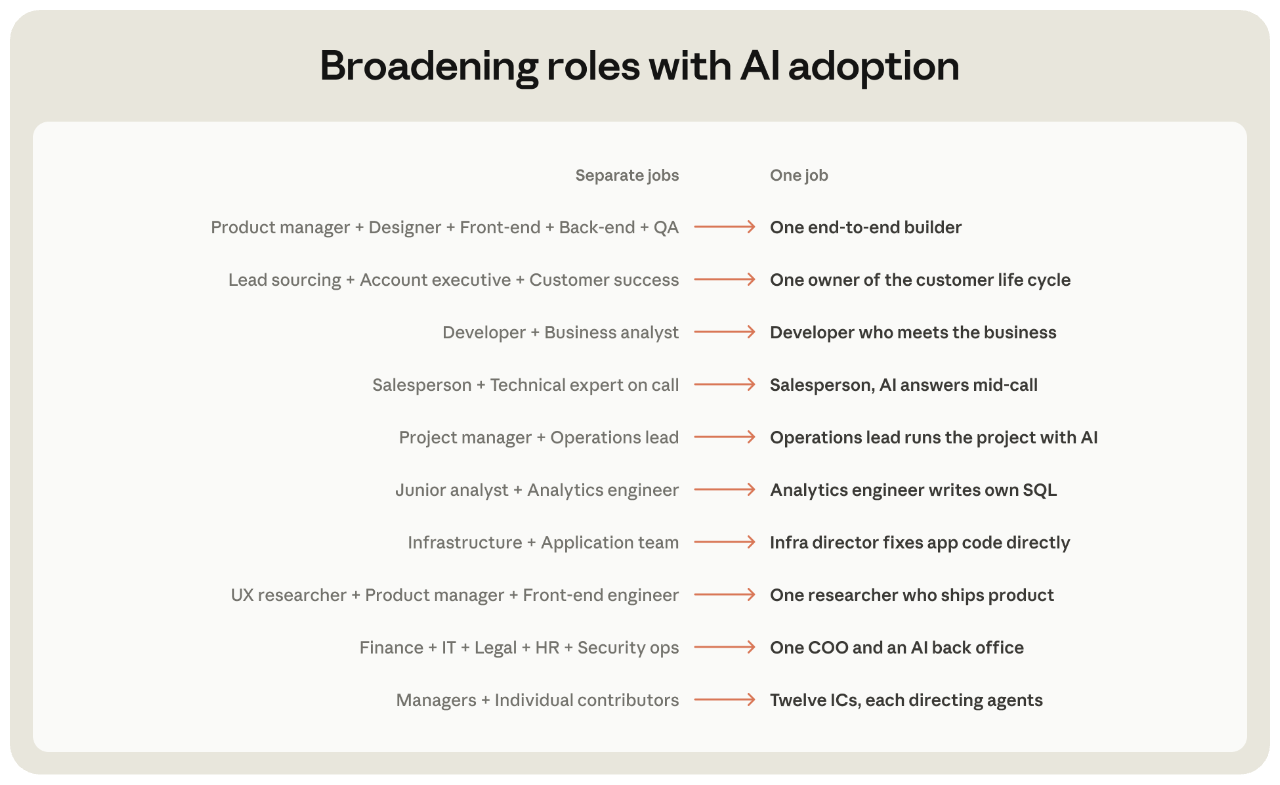
The core value creation mechanism of this role broadening lies in minimizing ‘Context Loss.’ In traditional organizations, bottlenecks occurred during handovers between lead generation, account management, and customer success, leading to information loss or delayed decisions. However, as AI tools assist in managing the details of individual stages, a single employee can transition into an integrated role managing the entire customer lifecycle. This simplifies organizational hierarchy and enables ‘ultra-small, high-efficiency’ team structures where a few people combined with AI can launch products rapidly.
The second core strategy is the redeployment to bottleneck tasks noted above. When productivity in one stage increases abnormally due to AI, a bottleneck inevitably occurs in the next stage. Analysis in the source paper (Figure 6 of the source paper) shows that as simple writing tasks are automated, the human role shifts sharply from ‘writing’ to ‘decision-making’ and ‘verification.’ Specifically, software engineers spend more time on UX testing, requirements definition, and code review than on writing code. This suggests that the value of strategic judgment—‘what to build’—has become higher than that of technical implementation.
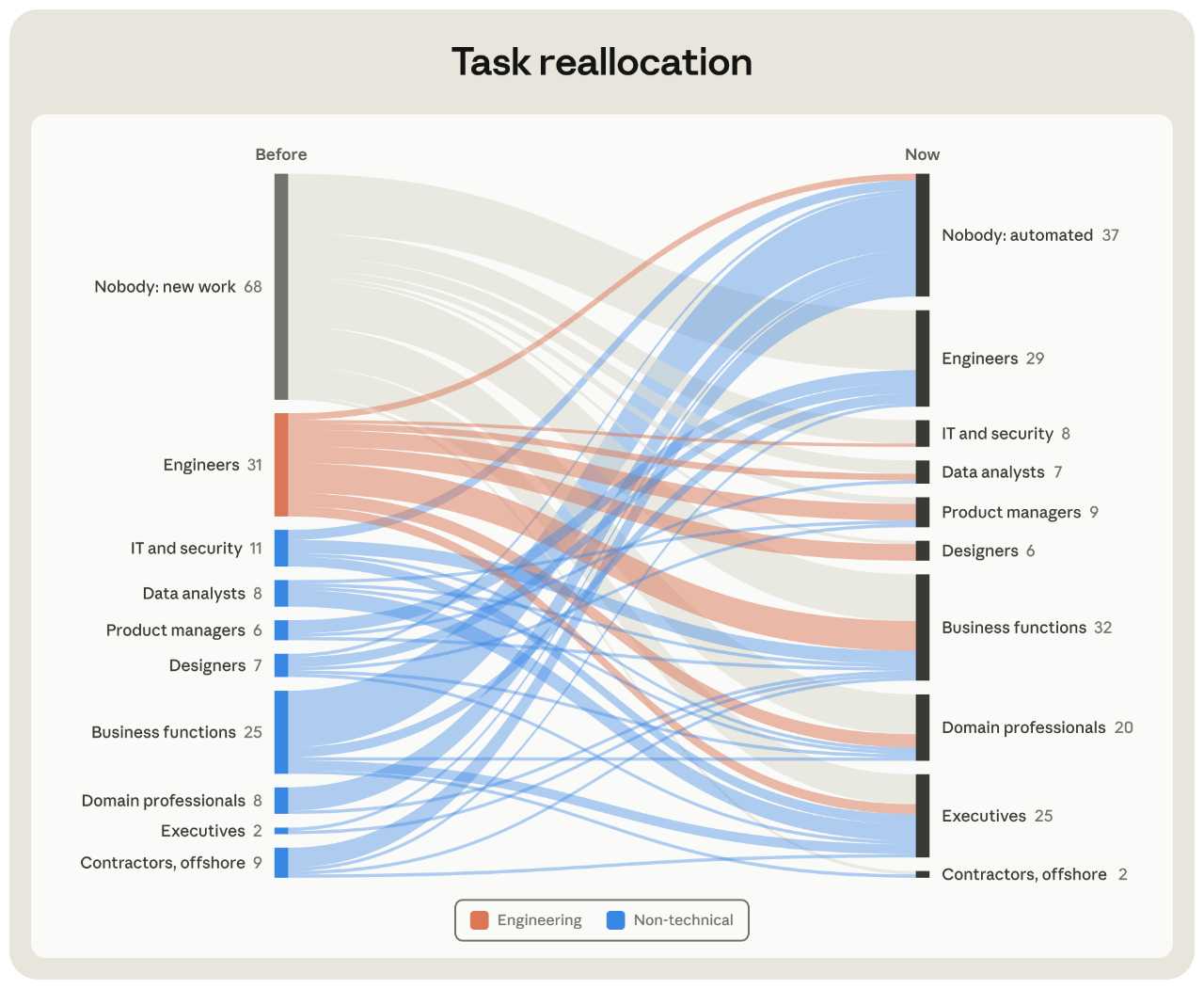
Specific examples of job redeployment are observed across various professional groups. CPAs transition from processing financial data to grading and verifying the accuracy of outputs produced by AI financial agents. Marketing executives move from designing individual documents to high-level control tasks, such as editing and managing prompts in skill files (skill.mds) containing brand guidelines. Additionally, production planners previously buried in spreadsheets take on the role of data labelers, providing qualitative context so AI agents can understand figures more accurately.
This redeployment process is more than a simple task change; it is a process of defining new competencies for professionals to survive in the AI era. Through interviews, the researchers present a path where ‘automation of existing tasks’ does not necessarily lead to ‘job reduction.’ A representative case is a contract manager at a construction firm who automated data collection and used the capacity to transition into a new role: enterprise AI integration and agent workflow maintenance. This is a model that achieves both job stability and productivity gains by using human expertise as a complement to AI.
Consequently, role broadening and job redeployment are high-level managerial acts that convert ‘idle time’ generated by AI into strategic organizational advantages. If an organization introduces AI while clinging to narrow job definitions, it will fall into an unbalanced state where some employees are overloaded while others have meaningless wait times. This eventually returns as technical debt in the form of political conflict and efficiency loss. Therefore, the success of an AI project is determined not by model performance improvement, but by the organizational design capacity to flexibly redeploy human resources according to shifting bottlenecks.
Expansion of Software Development Capabilities for Non-Technical Staff and the Role of Infrastructure
The proliferation of AI coding tools is lowering the barrier to software development, accelerating a phenomenon where non-technical staff build their own tools. According to the researchers’ analysis (Figure 3 of the source paper), while professional developers focus on product features or technical infrastructure, non-technical practitioners primarily use AI to create internal apps and dashboards. Examples include an accountant building an app to audit 401(k) disbursements or a plant quality supervisor building an app to monitor filtering speeds. This ‘vibe-coding’ phenomenon serves as a powerful productivity tool by immediately converting the field context held by domain experts into software functionality.
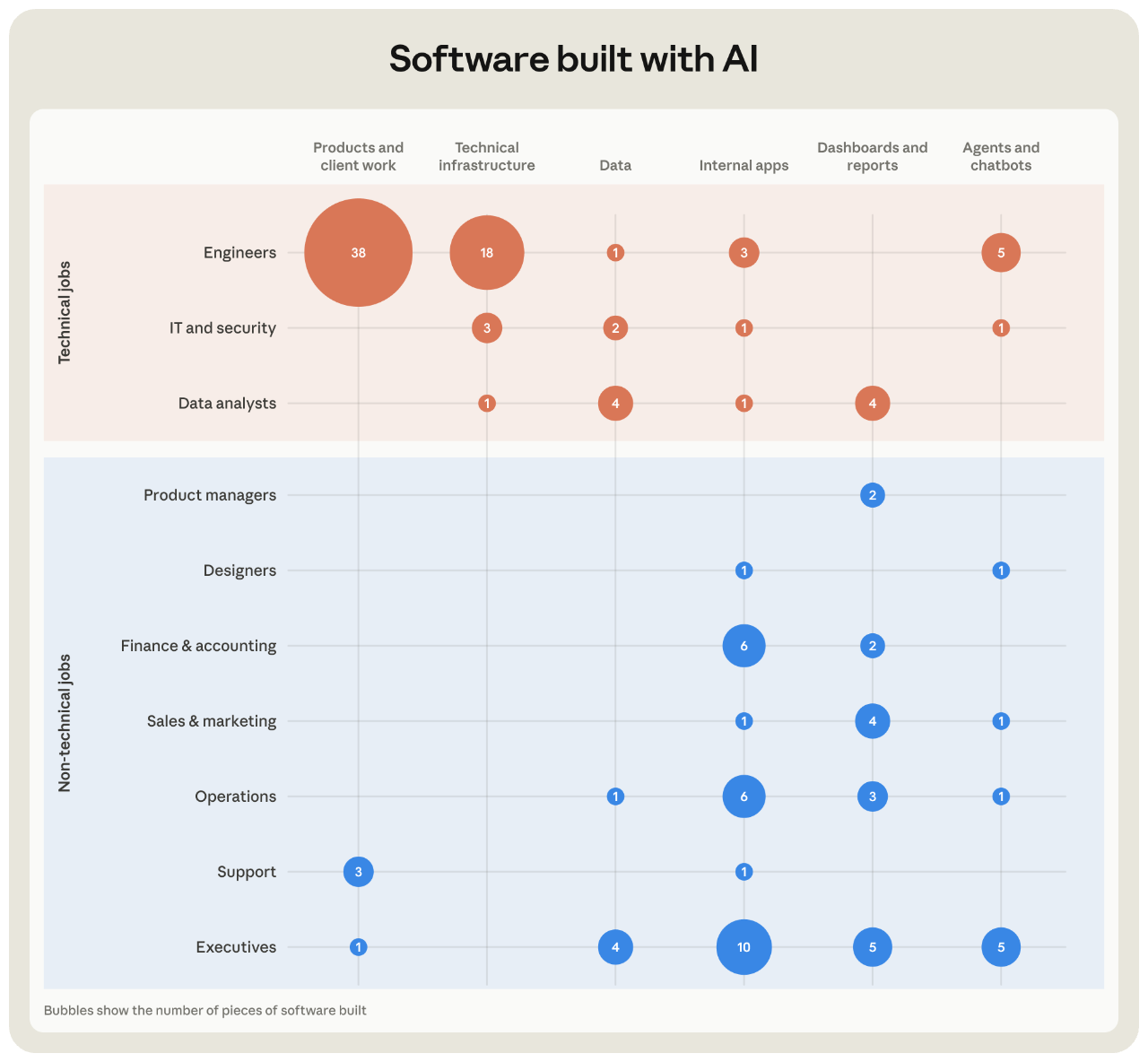
The key driver enabling this expansion of development capabilities for non-technical staff is the establishment of common infrastructure, such as data warehouses, and data democratization. When companies integrate fragmented data into a structure accessible to AI agents, practitioners no longer need to wait months in the data analysis team’s queue; they can execute SQL queries and derive analysis results directly. In the case of a transportation company, an environment where managers access the data warehouse directly for customized analysis drastically increases decision speed and shifts simple aggregation tasks—previously handled by reporting teams—into high-value insight generation.
However, this bottom-up software proliferation creates serious maintenance risks and technical debt at the organizational level. The first risk is the lack of maintenance sustainability. Tools built by non-technical staff have fast initial implementation speeds, but since the builders lack the expertise to fix them during model updates or API changes, they are highly likely to become ‘zombie apps.’ The research warns that while building directly may have lower initial costs than using SaaS products, it can be inefficient in terms of long-term maintenance costs and manpower.
The second risk is the exponential increase in security vulnerabilities. When every employee becomes a developer, the attack surface the enterprise must manage expands daily. When apps built by practitioners without security expertise access internal data or link to external APIs, a lack of proper permission control or verification procedures can lead to severe data breaches. This is a classic example of individual convenience neutralizing organizational security governance.
Third is the imbalance between software production speed and operational capacity. While AI has caused code generation speeds to explode, the infrastructural support (scaffolding) to review, deploy to production, and manage stability has not kept pace. The report cites cases where apps created by non-developers were eventually abandoned while waiting for third-party vendor implementation, or where multi-language translation features were implemented but later disabled because there was no staff to respond in those languages. This is the result of overlooking the gap between implementation and operation.
Ultimately, for the expansion of non-technical development capabilities to lead to real business value, a governance system linking ‘creation-review-operation’ must accompany the tools. Technical organizations must build pipelines to safely move non-technical tools into production environments and establish guardrails that automatically scan for security vulnerabilities. The spread of AI coding without such infrastructural support will cause uncontrollable software fragmentation, paradoxically increasing overall system complexity and slowing the speed of innovation in the long run.
Impact on Employment and Hiring
Unlike popular fears, the impact of AI adoption on the job market is complex and multi-layered. According to in-depth interviews with 58 companies, cases of directly firing full-time employees due to AI automation were extremely rare. In other words, the scenario where AI immediately replaces humans to cause mass layoffs is not the dominant phenomenon in current enterprise environments. However, this does not mean job stability is secured. The real employment shock is appearing not in the visible form of ‘layoffs,’ but in the invisible form of ‘reduced hiring.’
The first notable phenomenon is the suppression of new hiring. Approximately two-thirds of the interviewed companies reported reducing their hiring scale after adopting AI. This reduction occurs through two paths: attrition, where natural departures are not backfilled, and cases where the additional capacity provided by AI removes the need to hire new personnel for business expansion. An engineering leader at a healthcare company described this as “securing capacity by purchasing tokens instead of hiring people.” This suggests that even if AI does not directly push people out, it acts as a structural deterrent to employment by raising the barrier to entry for new talent.
Second, the group hit most immediately and broadly is offshore contractors and external vendors. The researchers confirmed that many companies terminated contracts with external contractors handling software development, customer service, legal consulting, and back-office work. Modular tasks—standardized work that can be isolated and delivered independently—were the primary targets for replacement. One company terminated its offshore design agency after obtaining high-quality results faster and cheaper via AI; another financial firm reduced more than 100 external data and development contractors.
The third risk factor is the fragmentation of jobs and the shift in power caused by top-down automation strategies. Attempts by management to automate specific workflows to achieve personnel efficiency put severe psychological pressure on practitioners. In particular, a ‘Panopticon Effect’ is emerging, where AI agents monitor human performance in real-time. An example is AI coding the content of customer service agent conversations across dozens of dimensions and sending them to a manager’s dashboard. While such surveillance systems may seem to refine performance management in the short term, they cause fatal side effects in the long run by undermining professional autonomy and destroying the foundation of trust within the organization.
Consequently, the real impact of AI on employment is closer to ‘reconfiguration’ and ‘entry blocking’ than ‘extinction’ of jobs. AI-native startups are aiming for extreme efficiency structures, minimizing back-office personnel and investing 90% of operational budgets into AI tokens, posing a serious challenge to traditional corporate operating models. If a company focuses solely on top-down automation driven by short-term ROI of labor cost reduction, it risks facing resistance from experts with core domain knowledge, leading to system rigidity or sinking into a swamp of technical debt through the production of unmaintainable ‘zombie apps.’
Therefore, to mitigate employment shocks and maximize AI value, strategic redeployment rather than simple headcount reduction is essential. Only organizations that convert the available time secured from automated repetitive tasks into ‘human-centric bottleneck tasks’—such as improving customer experience or strategic decision-making—can secure sustainable competitiveness. Ultimately, the employment strategy of the AI era will be determined by the ability to design ‘which high-value jobs to transition to’ using the time created by AI, rather than ‘whom to replace.’
Checklist for AI-Based Organizational Restructuring and Value Realization
- Identify Bottleneck Tasks: Have you quantitatively identified new bottleneck points occurring in the stages following AI-accelerated work?
- Expand Role Scope: Have you redesigned jobs so that individual practitioners own the entire workflow rather than a single function?
- Data Democratization Infrastructure: Have you established an environment where non-technical staff can directly access and analyze business data via SQL queries?
- Expert Feedback Loop: Have you involved domain experts in the AI workflow design stage and set their review tasks as key performance indicators (KPIs)?
- Flexible Personnel Redeployment: Have you transitioned available time secured from automated repetitive tasks into strategic judgment or interpersonal-centric tasks?
- Shadow AI Management: Do you have a governance system to promote or integrate personally created bottom-up AI tools into organizational standards?
- Quality Verification System: Do you have a ‘human-AI collaborative review’ process to efficiently filter and verify the large volume of AI-generated outputs?
- Continuous Role Updates: Do you have a process to update job descriptions every 3–6 months in line with the model performance improvement cycle?
AI ROI Determined by ‘Organizational Capacity’ Rather Than Technical Maturity
The implication of this report is clear. Enterprise AI failures occur not because of model accuracy or MLOps pipeline defects, but when the ‘vessel’—the organization—does not match the size and shape of the technology. While many companies view AI as a simple efficiency tool, it is actually a transformative technology that changes the organization’s operating system (OS).
Of particular note is the risk brought by the expansion of development capabilities for non-technical staff, such as ‘vibe-coding.’ While this appears as a productivity gain in the short term, it can lead to ‘code fragmentation’ with unclear maintenance ownership and an explosion of technical debt in the long term. Therefore, bottom-up adoption without prior standardization of data infrastructure and security governance is dangerous.
Furthermore, the mechanism where job insecurity leads to expert resistance provides very practical insight. To make experts perceive AI as ‘leverage’ rather than a ‘replacement,’ a clear vision and compensation system for ‘more valuable and advanced roles’ that follow simple task automation must be presented.
In conclusion, the core of AI strategy is not defining ‘what to automate,’ but defining ‘what humans will do after automation.’ Projects that fail to define this are likely to remain stuck in the PoC swamp or disappear without proving real ROI even after implementation.
Sustainable Organizational Operating Principles for the AI Era
To respond to the evolution of AI models and create real value, I propose five operating principles for leaders:
- Principle of Workflow Ownership: Define jobs by end-to-end workflow units rather than detailed functional units to minimize coordination costs.
- Bottleneck-Centric Staffing: Prioritize core personnel for human-centric bottleneck tasks occurring after AI acceleration, rather than at the points of acceleration themselves.
- Democratization of Data Access: Open infrastructure so all organization members can access data directly within safe guardrails, rather than confining analysis authority to a specific team.
- Expert-Agent Symbiosis Design: Restructure the job system so experts hold authority and responsibility as designers and final reviewers of AI systems.
- Dynamic Job Updates: Regularly review and modify job roles and responsibility scopes to reflect the model performance improvement cycle.
Further reading
- Analysis of AI-Driven Workflow Restructuring and Employment Shifts at Anthropic
- Cheating Behavior in Frontier Model Evaluations
- Evaluation Blindness: How Silent Measurement Failures Corrupt AI Systems from Training to Deployment
References and Original Analysis Materials
This research briefing was written from the source paper with the help of AI tools (AI Research Agent · MLOps, AI Research Agent · Strategy). Reviewed by Jay PARK, who is responsible for it.
Read more

Papers & Reports ·
How to Outcompete Your Client's AI

Papers & Reports ·
Risks of Governance Absence: Lessons from AI Adoption at the U.S. Small Business Administration (SBA)

Papers & Reports ·
Data and Methods for Identifying Artificial Intelligence-Related Patents

Papers & Reports ·
Cheating Behavior in Frontier Model Evaluations