Faster Code, Deeper Debt? Technical Debt and Early Signs in LLM-Assisted Software Development
Analysis of technical debt types and transition processes induced by LLM-assisted coding, warning of long-term maintenance risks and governance gaps.

Analysis shows LLM-assisted coding amplifies existing code, design, and documentation debt while creating new prompt and governance debt. This creates a tradeoff where short-term productivity gains lead to increased long-term maintenance costs and system complexity.
Introduction
In recent enterprise software development, the adoption of LLM-based coding assistants such as GitHub Copilot and Cursor is expanding rapidly. While many organizations are experiencing a dramatic increase in development velocity, this may simultaneously act as a mechanism for deferring invisible ‘technical costs’ to the future.
Code generated by LLMs may appear syntactically perfect, but it often ignores overall system architecture design principles or contains unverified logic. When developers uncritically accept AI output, an ‘Abstraction Prison’ is formed within the codebase—one that humans do not fully comprehend—which eventually returns as critical technical debt.
This analysis reviews 104 academic and industrial sources to examine how LLMs amplify existing technical debt and generate new forms of debt. Specifically, by analyzing the dangerous tradeoff between speed and quality, we derive implications for establishing sustainable engineering governance in an AI-native development environment.
What the Source Paper Says
To analyze the forms of technical debt introduced by LLM-assisted software development and the strategies, tools, and metrics to mitigate them, this study conducted a Multivocal Literature Review (MLV) of 104 sources, including 31 formal academic publications and 73 pieces of grey literature. Based on the classification system by Alves et al., the researchers analyzed how traditional technical debt manifests in LLM environments and identified new debt types unique to LLMs.
The results indicate that LLMs most frequently amplify code debt, design debt, and documentation debt. In particular, the occurrence of ‘fast-integration debt’ triggers a domino effect leading to governance debt, thereby increasing long-term maintenance costs. Furthermore, LLM-specific debt types such as prompt debt, data debt, ethical debt, and provenance debt were newly defined.
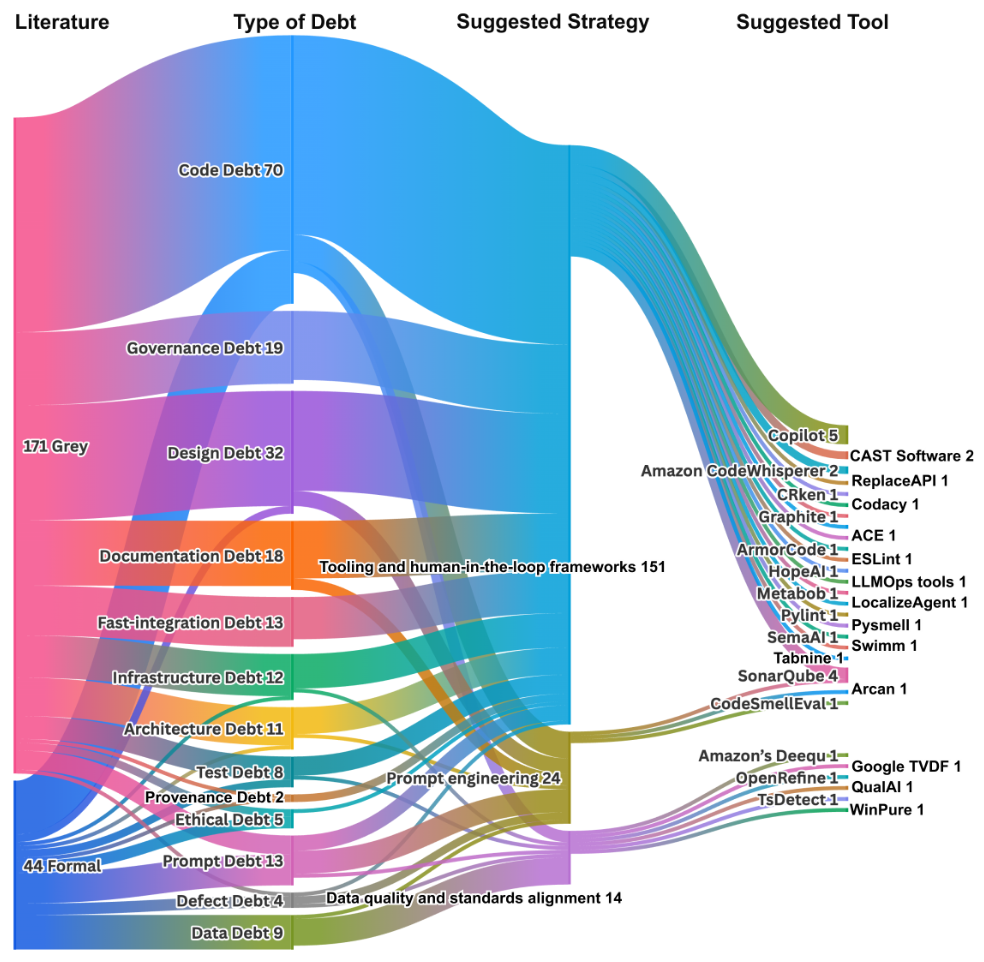
Proposed mitigation strategies include human-in-the-loop frameworks, sophisticated prompt engineering, and data quality alignment. While static analysis tools like SonarQube are still in use, the study confirmed a persistent lack of standardized benchmarks and dedicated metrics capable of quantitatively evaluating the semantic consistency or maintainability of LLM-generated code.
Executive Key Takeaways
- 1 1. [Amplification and Generation of Debt] Rapidly integrating LLM-generated code without sufficient understanding and verification accelerates existing code/design debt and accumulates new forms of technical debt, specifically prompt and governance debt.
- 2 2. [Productivity-Maintenance Tradeoff] Enterprise leaders must enforce human-in-the-loop review systems that prioritize code comprehensibility and maintainability over AI-driven 'development velocity' metrics.
- 3 3. [Absence of Dedicated Metrics] How can we build standardized benchmarks to quantitatively measure semantic errors and architectural inconsistencies unique to LLM-generated code that are not captured by static analysis tools?
How LLM-Assisted Coding Destroys Long-Term Software Maintainability?
First, it exponentially amplifies existing code and design debt. According to the researchers’ analysis, developers tend to integrate LLM outputs without sufficient understanding, leading to increased code duplication and reduced reusability. Specifically, an analysis by GitClear (referenced in the source paper) confirmed that between 2020 and 2024, simple copy-paste duplication in the code of major tech companies grew faster than reuse through refactoring. This indicates that while LLMs increase short-term functional implementation speed, they ultimately increase system complexity and maintenance costs.
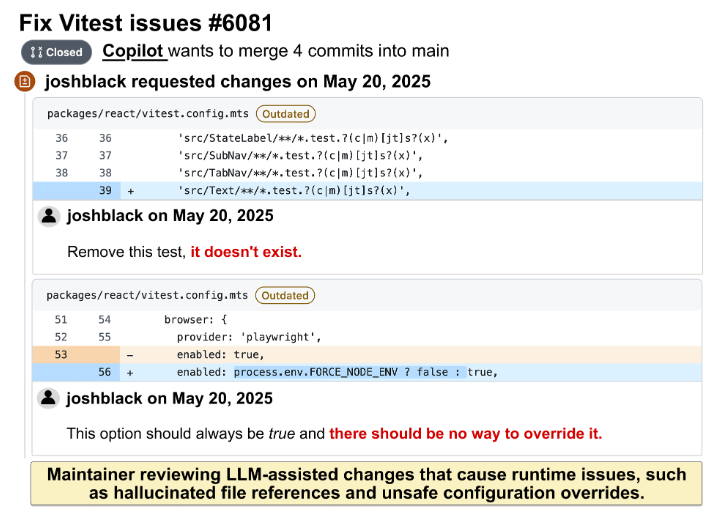
Second, it creates a new failure path called ‘fast-integration debt.’ This stems from the practice of rapidly deploying AI-generated code by prioritizing speed over quality. According to the source paper, while this approach initially shows impressive development velocity metrics, it eventually triggers a domino effect where bugs emerge simultaneously in edge cases that the AI failed to consider. This transitions into ‘governance debt,’ requiring continuous monitoring and correction of the entire system, generating massive operational costs that offset initial productivity gains.
Third, the absence of quantitative measurement tools prevents the early detection of debt accumulation. Static analysis tools currently used in the industry, such as SonarQube, can detect syntax errors or general code smells, but they cannot measure the semantic inaccuracies, architectural inconsistencies, or non-deterministic behavior resulting from prompt vulnerabilities unique to LLM-generated code. The researchers warn that in the absence of standardized benchmarks, developers tend to misjudge AI output as correct simply because it ‘works,’ creating a risk where technical debt remains invisible until it reaches a critical tipping point.
Just because AI-generated code passes tests and is deployed to production does not mean it is ‘correct code.’ Accepting code without fully understanding its logic and assumptions is akin to erecting invisible bars within the codebase.
If this state persists, the system becomes trapped in an ‘Abstraction Prison’ where it functions, yet no one can explain its internal operational principles. This transcends simple degradation of code quality; it completely blocks the system’s evolvability and creates extreme vulnerability where a minor change could collapse the entire system.
Analysis of 6 New LLM-Specific Technical Debt Types
LLM-based software development not only amplifies existing technical debt but also generates entirely new forms of debt stemming from the characteristics of generative AI. The six new debt types presented by the researchers (Table 8 of the source paper) extend beyond simple code quality to the domains of governance, ethics, and data.
The first is Governance Debt. This refers to the long-term monitoring burden resulting from the hallucination and non-deterministic nature of LLMs. Code often appears correct on the surface but contains logical flaws, forcing continuous human intervention and review to maintain it. This ultimately acts as a risk that generates massive management costs during the operational phase.
The second is Prompt Debt. Although prompts are key artifacts that determine the nature of the resulting implementation, they tend to be less rigorously version-controlled or documented than source code. Unclear or unoptimized prompts hinder the reproducibility of results and create vulnerabilities where small input changes lead to large-scale architectural entropy.
The third is Fast-integration Debt. This originates from the practice of ‘Vibe Coding,’ where AI suggestions are immediately reflected without a verification process. While initial development speed rises dramatically, edge cases overlooked by the AI surface simultaneously over time, destabilizing the system’s foundation.
The fourth is Data Debt. This refers to the phenomenon where noise or low-quality data from training sets is transferred directly into the generated code. Specifically, when the quality of context data referenced in a RAG (Retrieval-Augmented Generation) pipeline is low, it leads directly to defects in downstream code, incurring unexpected costs during maintenance.
The fifth is Ethical Debt. This refers to the accumulation of unfairness or ambiguity in accountability inherent in code generated from biased training data. Such debt is not visible during the development phase but leads to critical outcomes that directly harm end-users or amplify the organization’s social responsibility risks.
The sixth and final type is Provenance Debt. This refers to the legal and managerial risks arising from the unclear ownership and traceability of AI-generated code. As code duplication becomes more frequent, the possibility of license violations increases, making it difficult to define accountability for software assets.
Amplification Mechanisms and Frequency of Traditional Technical Debt
In LLM-based development environments, technical debt does not simply increase in quantity; it manifests by accelerating existing debt generation mechanisms. Analysis applying the classification system of Alves et al. (Table 8 of the source paper) put the counts for the three debts noted above at Code Debt 56 cases, Design Debt 30 cases, and Documentation Debt 17 cases. This suggests that the superficial completeness of LLM-generated code leads developers to skip critical review processes, resulting in the mass production of low-quality, unmaintainable code.
First, the amplification of code debt stems from the practice of integrating code without fully understanding the LLM’s logical reasoning. Since LLMs generate code based on statistical patterns, they often commit errors in detailed business logic or edge cases. According to a Tabnine analysis cited in the source, developers spend more time debugging or rewriting code generated for complex logic that fails to work, which ultimately increases duplication and overall complexity within the codebase.
Second, design debt is accelerated because LLMs fail to understand a specific system’s unique architecture or internal conventions. While LLMs are proficient at optimization at the individual function or module level, they lack the ability to maintain design principles and consistency across the entire system. Consequently, cases where generated code conflicts with existing architecture or violates design principles are frequent, posing a critical risk that hinders system flexibility and exponentially increases future refactoring costs.
Third, documentation debt deepens as the explosive growth rate of AI-generated code outpaces documentation efforts. Developers focus on immediately applying AI-generated solutions and tend to neglect recording the background or specific assumptions behind the introduced code. The source warns that this phenomenon hinders knowledge transfer within teams and increases the cognitive cost for new members to understand the system, thereby degrading long-term operational efficiency.
Consequently, LLMs act as catalysts that amplify traditional technical debt through vulnerabilities such as hallucinations and insufficient testing. While this may appear to increase development speed in the short term, it actually results in the accumulation of unverified logic and fragmented design, blocking the system’s evolvability. Therefore, it is essential to apply rigorous governance from the code level up to the architectural level, rather than being blinded by AI-assisted productivity metrics.
Limitations of Existing Mitigation Strategies and Tools
Tools currently deployed to detect and mitigate technical debt in LLM-assisted development environments are divided into commercial static analysis tools and academic research prototypes. Looking at the tool list (Table 9 of the source paper), static analysis tools such as SonarQube, Snyk, ESLint, and Pylint are most widely used. These tools perform excellently in identifying syntax errors, general code smells, vulnerabilities, and duplicated code. However, because these tools were designed from a traditional software engineering perspective, they have fundamental limitations in capturing the sophisticated defects unique to LLM-generated code.
The first limitation is that static analysis tools cannot identify the semantic debt of AI-generated code. Static analysis checks the form of the code and adherence to rules, but it cannot judge whether the code actually operates correctly within the business context or aligns with the overall system architectural design principles. This means that even if code is syntactically perfect and passes a linter, it may internally contain logical flaws or hallucinations. Consequently, developers risk making dangerous judgments by trusting the ‘pass’ signal from the tool and transferring potential debt directly into the production environment.
Second, research prototypes such as QualAI or CodeSmellEval proposed in academia attempt more precise diagnosis but have low field applicability. CodeSmellEval attempts to quantify early signs of debt by introducing a Propensity Smelly Code (PSC) metric to measure the likelihood of code smells in LLM-generated code. Additionally, QualAI proposes a framework for continuous debt monitoring across the entire lifecycle of AI-based systems. However, these research-oriented approaches are still in early stages and lack the scalability and universality required for immediate integration into CI/CD pipelines for large-scale codebases.
The most critical risk is the complete absence of standardized benchmarks to evaluate the maintainability and long-term quality of LLM-generated code. According to the source analysis, most existing benchmarks focus on binary correctness—simply whether the code executes. This results in confirming only short-term functional success, completely overlooking maintainability metrics such as how easily the code can be modified a year later or how strongly it is coupled with other modules, which increases change costs.
Ultimately, the absence of standardized metrics and dedicated tools prevents the ‘visualization’ of the technical debt accumulation process. Developers and organizations fall into the illusion of short-term productivity gains provided by AI, while actually deferring unmanageable levels of complexity and maintenance costs to the future. Unless this measurement gap is resolved, AI-based development is merely a ‘race for speed’ without a quality management system, which is highly likely to become a massive swamp of technical debt leading to the collapse of the entire system.
Analysis Methodology and Source Selection Process
This study adopted the Multivocal Literature Review (MLR) methodology to secure both academic rigor and practical perspectives from the industrial field. By integrating formal literature with grey literature such as blogs, online forums, and industry reports, the researchers supplemented the real-time field issues and latest practical trends that academic papers often fail to capture. To achieve this, the researchers underwent a multi-stage search query optimization process, ultimately building a sophisticated query string combining ‘technical debt’ and its 13 sub-categories with keywords such as ‘LLM’ and ‘AI-generated code’ to extract relevant sources from databases and search engines.
First, in the selection process for grey literature, SerpAPI (Google Search API) was used to explore approximately 370,000 results while minimizing bias. The researchers identified the point where relevance saturated within the top 10 pages of search results and initially selected 132 unique sources. Subsequently, a quality evaluation was performed based on 22 detailed criteria across six categories: Authority, Methodology, Objectivity, Date, Significance, and Impact. Only sources with a score of 50% or higher were finally included to ensure verifiable industrial insights rather than mere personal opinions. As a result, 73 high-quality grey literature sources were selected, primarily consisting of corporate blogs (38) and developer platforms (18).
Second, the selection of formal literature was conducted through four major academic databases: ACM Digital Library, IEEE Xplore, Springer Link, and Elsevier ScienceDirect. Strict inclusion and exclusion criteria were applied to a total of 551 papers. Specifically, papers dealing simply with the functional accuracy or success rates of LLMs were excluded, and only those explicitly addressing long-term maintainability and degradation of code quality from the perspective of ‘technical debt’ were selected. Additionally, a snowballing technique—tracking references of selected papers and subsequent studies citing them—was used to supplement missing core research, finalizing 31 formal publications.
Finally, to increase the reliability of the extracted data, a cross-verification process was operated where two researchers independently completed data extraction forms, and a third researcher reviewed them to resolve discrepancies. In particular, when classifying technical debt types, Cohen’s Kappa Coefficient was calculated to measure inter-rater agreement, recording a very high agreement of 0.90 or higher across most metrics. This systematic methodology serves as the basis for proving the risk of long-term technical debt hidden behind short-term productivity metrics of LLM-generated code using objective figures and cases.
Checklist for Preventing Technical Debt when Introducing LLM-Assisted Development
- Enforcement of Human-in-the-loop: Has a mandatory process been defined for logical verification and code review by senior engineers for all AI-generated code?
- Prompt Assetization and Version Control: Are prompts used to generate code version-controlled and documented alongside the code—rather than treated as disposable—to ensure reproducibility?
- Semantic Verification beyond Static Analysis: Beyond existing tools like SonarQube, has unit test and regression test coverage been strengthened to verify edge cases of AI-generated code?
- Identification and Tracking of AI Contributions: Is there traceability to distinguish AI-generated areas from human-written areas in the codebase to prioritize debt repayment (refactoring) in the future?
On the Illusion of ‘Speed’ in the AI-Native Development Era
The most painful point highlighted by this study is that the metric of ‘productivity improvement’ provided by AI may actually be synonymous with the ‘acceleration of debt.’ While many companies celebrate the increased speed of ticket processing after AI adoption, this is likely the result of rapidly churning out outputs while skipping essential processes such as sophisticated design and verification. The frightening aspect of technical debt is that interest compounds, and AI is dramatically increasing that interest rate.
In particular, the method known as ‘Vibe Coding’—interacting with AI based on feeling and intuition without rigorous specifications—is extremely dangerous in an enterprise environment. This is because it completely ignores deterministic design and traceability, the foundations of software engineering. Ultimately, true competitiveness in the AI era will be determined not by ‘how fast one can write code,’ but by ‘how to maintain the center of quality and governance amidst the vast amount of code poured out by AI.’
Three Principles for Sustainable AI-Assisted Development
To ensure that short-term speed increases do not lead to long-term system collapse, engineering leaders should adhere to the following principles:
- Prioritize Understanding over Speed: Before integrating AI-generated code, the developer must be able to perfectly explain the internal logic and the impact the code has on the system architecture; code that cannot be explained must never be integrated.
- Treat Prompts as First-Class Development Artifacts: Consider prompts as part of the code, subjecting them to version control, review, and documentation processes to control the non-determinism of AI outputs and ensure reproducibility.
- Include Verification Costs in Development Costs: A certain percentage of the coding time saved by AI must be reallocated to in-depth reviews, edge case testing, and refactoring time to establish an immediate debt repayment system.
Further reading
- Hidden Technical Debt in Machine Learning Systems
- An Empirical Study on Self-Admitted Technical Debt in AI Agents
- Understanding Self-Admitted Technical Debt in Test Code: An Empirical Study
References and Source Analysis Data
Faster Code, Deeper Debt? A Multivocal Literature Review on Technical Debt and Its Early Signs in LLM-Assisted Software Development
Authors: Ramtin Ehsani, Shriya Rawal, Yuanfang Cai, Preetha Chatterjee
This research briefing was written from the source paper with the help of AI tools (AI Research Agent · MLOps, AI Research Agent · Strategy). Reviewed by Jay PARK, who is responsible for it.
Read more

Papers & Reports ·
Working with AI: AI Adoption Strategies and Organizational Restructuring Based on Anthropic Enterprise Customer Interviews

Papers & Reports ·
How to Outcompete Your Client's AI

Papers & Reports ·
Risks of Governance Absence: Lessons from AI Adoption at the U.S. Small Business Administration (SBA)

Papers & Reports ·
Data and Methods for Identifying Artificial Intelligence-Related Patents