Optimizing Labeling Efficiency for Architecture Technical Debt Detection via Active Learning and Explainable AI
Proposes a pipeline combining Active Learning and XAI for Jira-based Architecture Technical Debt detection, reducing labeling costs by 49% while improving performance.

This research proposes a pipeline combining keyword filtering, Active Learning, and XAI to resolve high labeling costs in Architecture Technical Debt (ATD) detection. A BERT model using the Breaking Ties strategy achieved an F1 score of 0.72, reducing labeling costs by approximately 49%.
Introduction
In enterprise software systems, Architecture Technical Debt (ATD) is a critical risk that transcends simple code-level defects, undermining the maintainability and scalability of the entire system. However, automated detection requires large-scale, high-quality labeled data. Because architectural judgment necessitates the intervention of engineers with high-level expertise, data construction costs increase exponentially.
Many AI projects demonstrate high accuracy during the PoC phase only to fail when confronted with the complex datasets of actual production environments. This occurs because they fail to resolve the tradeoff between ensuring training data diversity and managing labeling costs. This analysis examines how to build a reliable technical debt detection model while minimizing expert intervention through Active Learning and Explainable AI (XAI).
Key Findings of the Original Paper
This research addresses a methodology for efficiently detecting Architecture Technical Debt (ATD)—which possesses structural influence at the system level—among Self-Admitted Technical Debt (SATD) explicitly recorded by developers in code comments or issue trackers. The researchers utilized Jira issue data collected from 10 open-source Java projects. Based on a seed dataset of 57 cases verified by experts, they filtered candidates using three keyword extraction techniques: TF-IDF, KeyBERT, and CS KeyBERT.
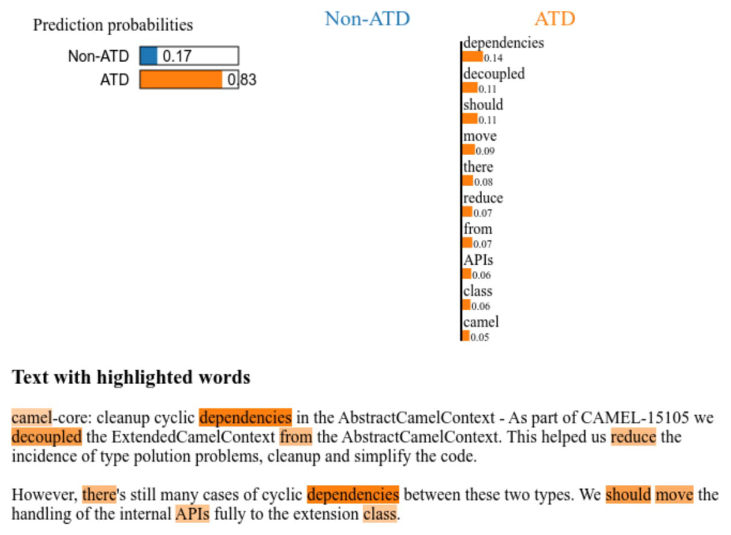
Subsequently, the researchers analyzed labeling efficiency by applying six Active Learning query strategies to a BERT model. Experimental results showed that the Breaking Ties strategy performed best, achieving an F1 score of 0.72 with only 51% (1,700 samples) of the total dataset. This simultaneously secured higher performance and cost-efficiency compared to full-dataset training (Baseline BERT, F1 0.66). Furthermore, the researchers visualized the model’s reasoning using LIME and SHAP, and expert evaluations confirmed that LIME was preferred for its intuitiveness and accessibility.
Executive Key Takeaways
- 1 1. [Core Analysis Result] Architecture technical debt is abstract and context-dependent, leading to very high manual labeling costs for experts and low recall issues when using general keyword matching.
- 2 2. [Practical Implications] In environments with limited expert resources, uncertainty-based active learning strategies such as Breaking Ties should be implemented to optimize the samples targeted for labeling and maximize learning efficiency.
- 3 3. [Remaining Limitations] What is the actual break-even point between the computational costs arising from the iterative retraining of BERT-based models and the reduction in human expert labeling costs?
Is it actually possible to increase detection performance while reducing expert labeling costs?
First, there are the limitations of keyword-based filtering and the issue of low recall. Although the researchers extracted over 100,000 candidates using TF-IDF and KeyBERT, expert verification revealed that the detection rate for True-ATD remained between 21% and 33%. This suggests the existence of significant ‘invisible debt’ that cannot be captured by simple lexical similarity, as architectural debt is often described using project-specific metaphors or implicit contexts.
Second, there is the performance variance and data efficiency according to the active learning strategy. When using uncertainty-based query strategies such as Breaking Ties instead of Random Sampling, the model recorded a higher F1 score (0.72 vs 0.66) using only half (51%) of the dataset compared to the baseline model trained on the full dataset. This proves that prioritizing the learning of ‘borderline samples’—which the model finds difficult to classify—is far more effective for improving generalization performance than simply increasing data volume.
Third, there is a gap between model interpretability and expert trust. When reasoning was presented via SHAP and LIME, experts preferred LIME’s intuitive bar chart explanations. Conversely, instances occurred where XAI tools identified general words irrelevant to architecture, such as ‘from’ or ‘class’, as important features. This indicates a risk that black-box models may rely on statistical noise rather than actual architectural logic, highlighting the need for additional feature engineering to filter such noise.
In environments where expert resources are extremely limited, instead of attempting to build a precision model from the start, implement a phased pipeline: ‘Keyword Filtering (Triage) Active Learning XAI Verification’.
Specifically, the Breaking Ties strategy, which prioritizes the extraction of high-uncertainty samples, serves as a practical alternative to optimize performance while reducing labeling costs by nearly half.
Detailed Design of the Hybrid Pipeline for ATD Detection
The Architecture Technical Debt (ATD) detection pipeline proposed by the researchers (Figure 1 of the source paper) consists of a six-step sequential flow designed to optimize expensive expert resources. The core of this framework is not merely model training, but the strategic placement of expert intervention from the data generation stage to reduce labeling costs while ensuring data reliability.
The first step is the construction of the seed dataset and definition of the annotation scheme. The researchers re-examined 116 cases from previous research to secure 57 refined seed data points agreed upon unanimously by all authors. ATD was defined based on two metrics: Violation of Modularity and Using Obsolete Technology. Accuracy was increased by distinguishing between clear cases (‘True-ATD’) and borderline cases (‘Weak-ATD’).
The second and third steps involve data preparation and keyword-based filtering. Using large-scale Jira issue data from 10 open-source Java projects as input, core ATD-related vocabulary is extracted via TF-IDF, KeyBERT, and CS KeyBERT. The extracted keywords are compared against Jira issue text through n-gram chunking and cosine similarity analysis; issues with a similarity score of 0.9 or higher are automatically classified as ATD candidates. This operates as a triage mechanism to remove noise from the vast dataset.
In the fourth step, supervised learning based on Active Learning is performed. Using a BERT model as the primary learner, the system employs uncertainty-based query strategies rather than random sampling to prioritize informative samples that the model finds most difficult to learn for expert labeling. This iterative loop implements an efficient learning structure that maximizes predictive performance while reducing the volume of training data.
The final fifth and sixth steps are ensuring explainability and expert verification. To address the black-box nature of the trained BERT model, explainable AI (XAI) techniques—LIME and SHAP—are applied. When the tokens serving as the basis for the model’s ATD judgment are visualized, software engineering experts qualitatively evaluate them across eight dimensions to verify if the model’s logic aligns with actual architectural principles. This closed-loop structure ensures that the AI model’s output is based on engineering evidence trusted by domain experts rather than simple statistical probability.
Comparative Performance Analysis by Active Learning Query Strategy
The core of Active Learning (AL) is for the model to select the most useful samples for its own learning to minimize labeling costs. Based on a BERT model, the researchers analyzed ATD detection performance and data efficiency across six query strategies: Prediction Entropy, Least Confidence, Breaking Ties, Embedding K-Means, Contrastive Active Learning, and a control group of Random Sampling.
According to the figures in the source paper (Table 8 of the source paper), performance variance is distinct based on labeling settings. When training only on clear ‘True-ATD’ cases, the F1 score remained within a narrow range of 0.63 to 0.68. However, integrating borderline ‘Weak-ATD’ cases significantly improved overall performance. Specifically, the Breaking Ties strategy recorded the highest F1 score of 0.72 in the integrated setting.
Results regarding data efficiency are even more encouraging. According to the analysis (Figure 5 of the source paper), the Breaking Ties strategy reached peak performance with only 1,700 samples, representing 51% of the total dataset. In contrast, Random Sampling achieved an F1 score of only 0.68 even after training on 2,500 samples (75% of the dataset), demonstrating that Active Learning can drastically reduce expert labeling effort. While Contrastive Active Learning showed scalability with steady performance gains as data increased, Breaking Ties was overwhelmingly efficient in the early learning stages.
Ultimately, the BERT-Breaking Ties combination achieved an F1 score of 0.72, surpassing the baseline BERT model trained on the full dataset (F1 0.66). This result indicates that labeling resources were reduced by approximately 49% while actually increasing predictive accuracy, suggesting that Active Learning is a viable practical alternative for ATD detection, where high-level expertise is required. However, this efficiency comes with a tradeoff in computational costs due to iterative model retraining; therefore, a strategic approach is needed in production to find the optimal balance between expert labor costs and computing resource costs.
LIME vs SHAP: Interpretability Evaluation from an Expert Perspective
Transformer-based models provide high predictive performance but possess a black-box nature with opaque internal mechanisms. To resolve this, the researchers introduced model-agnostic explanation techniques—LIME (Local Interpretable Model-agnostic Explanations) and SHAP (SHapley Additive exPlanations)—to analyze which text tokens the BERT model used to identify ATD. The effectiveness of these two techniques was quantitatively verified through eight XAI evaluation metrics with 10 experts.
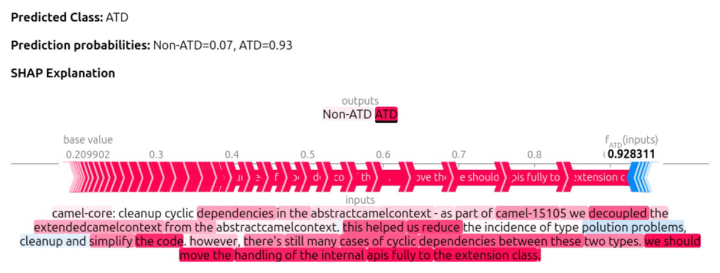
Analysis results (Table 10 of the source paper) show that LIME was rated higher than SHAP across most metrics. First, there is a significant gap in Accessibility and Causality. LIME scored 4.00 in Accessibility and 4.10 in Causality, overwhelmingly surpassing SHAP (2.40 and 3.10, respectively). This suggests that experts more clearly understood the model’s decision path through LIME’s intuitive bar chart visualizations. Second, LIME also secured higher scores in Trustworthiness (3.40) and Fairness (3.80) than SHAP.
Conversely, SHAP scored slightly higher in Informativeness (3.50) than LIME (3.30). This is because SHAP precisely calculates the contribution of each feature mathematically based on game theory, providing more detailed and theoretically robust information about the inference process. Some experts noted that SHAP’s highlighted text provided deeper insight into the model’s decisions. However, this detail did not necessarily translate to a better user experience; in fact, SHAP’s output was pointed out as being more confusing for users without machine learning expertise.
Consequently, 50% of the experts ultimately preferred LIME, primarily due to its clarity and ease of use. This proves that when deploying AI models in an enterprise environment, ‘intuitive explainability’ that stakeholders can accept plays a more decisive role in building trust than simple mathematical accuracy.
Performance Comparison with Traditional Machine Learning Models
The key to Architecture Technical Debt (ATD) detection lies in the ability to grasp sophisticated context. To objectively verify the performance of the proposed BERT-Breaking Ties model, the researchers performed a comparative analysis against traditional machine learning models and state-of-the-art deep learning benchmarks. According to the figures (Table 9 of the source paper), the Transformer-based approach overwhelmingly outperformed traditional statistical models and machine learning algorithms.
First, there was a consistent performance degradation among traditional machine learning models. Logistic Regression (LR) and Multinomial Regression (ME) performed relatively well with F1 scores of 0.67 and 0.65, respectively, but Support Vector Machine (SVM), k-Nearest Neighbors (kNN), and Random Forest (RF) showed low values of 0.62, 0.61, and 0.59. The Naïve Bayes (NB) model performed the worst, with a recall of 0.50 and an F1 score of 0.41. This suggests that simple keyword frequencies or linear decision boundaries are insufficient to capture the abstract and complex linguistic patterns characteristic of architectural debt.
Second, there was a performance gap between deep learning and Transformer models. TextCNN showed decent performance with an F1 score of 0.67, but high-performance Transformer models such as RoBERTa, ALBERT, and DeBERTa-v3 yielded superior results. Specifically, the BERT-Breaking Ties model achieved the highest performance among all compared models, with a precision of 0.72, recall of 0.71, and F1 score of 0.72. This proves that learning from refined, high-value samples via Active Learning led to more substantial performance gains than simple changes to the model architecture.
Consequently, relying on traditional machine learning models is likely to result in critical False Negative risks in ATD detection. Because architectural debt is described far more implicitly and context-dependently than code-level defects, the adoption of Transformer-based models capable of learning deep semantic relationships in text is essential. Furthermore, the fact that the BERT-Breaking Ties model using only 51% of the dataset outperformed the baseline BERT model (F1 0.66) trained on the full dataset demonstrates that learning efficiency through strategic sampling, rather than quantitative data expansion, is a key success factor in building enterprise-grade AI models.
Review Checklist Before Deploying an ATD Detection Model
- Conservative Selection of Seed Dataset: Was the seed data for initial keyword extraction limited to high-purity data agreed upon by all experts to prevent noise propagation?
- Appropriateness of Query Strategy: Was an uncertainty-based strategy, such as Breaking Ties (selecting samples with the minimum prediction margin), applied instead of simple random sampling?
- Inclusion of Weak-ATD in Training: Was the model’s decision range expanded by including borderline Weak-ATD cases in addition to explicit True-ATD cases?
- XAI-based Verification of Reasoning: Did experts review whether the important tokens selected by the model hold actual architectural meaning or are merely project-specific noise?
Strategy for Escaping the ‘Data Swamp’ in Enterprise AI Projects
The core finding of this research is the empirical demonstration that AI model performance is determined by ‘Informativeness’ rather than the ‘volume’ of data. Many companies outsource the simple labeling of tens of thousands of cases, yet model performance stagnates because the majority of the data is redundant or low in informative value. In domains requiring high expertise, such as architectural debt detection, an Active Learning system is essential—one that utilizes experts as ‘oracles’ to identify the points where the model struggles most, rather than consuming them as simple labelers.
Practically, however, the computational cost of iterative retraining when using large models like BERT must be considered. While labeling costs decrease, there is a tradeoff involving increased GPU costs and pipeline complexity. Therefore, a strategic approach is required: test query strategies with lightweight models initially and apply high-performance Transformer models only during the final model confirmation phase.
Principles for Building a Reliable Debt Detection System
To function as an actual decision-support tool rather than a simple alert tool, automated technical debt detection tools should adhere to the following principles:
- Value-Centric Labeling: Optimize expert resources by prioritizing the acquisition of high-value samples that resolve model uncertainty over indiscriminate data collection.
- Visualization and Verification of Reasoning: AI detection results must include XAI-based evidence, which should be periodically audited by domain experts to remove model bias and noise.
- Incremental Label Expansion Strategy: Ensure both stability and generalization performance by expanding the learning scope step-by-step, starting from clear cases (True-ATD) and moving toward ambiguous cases (Weak-ATD).
Further reading
- A Multivocal Review of MLOps Practices, Challenges and Open Issues
- Hidden Technical Debt in Machine Learning Systems
- Analysis of AI-Driven Workflow Restructuring and Employment Shifts at Anthropic
References and Original Analysis Data
Reducing labeling effort in architecture technical debt detection through active learning and explainable AI
This research briefing was written from the source paper with the help of AI tools (AI Research Agent · MLOps, AI Research Agent · Strategy). Reviewed by Jay PARK, who is responsible for it.
Read more

Papers & Reports ·
Working with AI: AI Adoption Strategies and Organizational Restructuring Based on Anthropic Enterprise Customer Interviews

Papers & Reports ·
How to Outcompete Your Client's AI

Papers & Reports ·
Risks of Governance Absence: Lessons from AI Adoption at the U.S. Small Business Administration (SBA)

Papers & Reports ·
Data and Methods for Identifying Artificial Intelligence-Related Patents